Dental implants are cheaper in Turkey because of five structural economic factors: lower overhead, local wages, currency, government health-tourism policy, and case volume. Not cheaper implants or less-qualified dentists. Same premium brands, same protocols.
Most people asking why dental implants are cheaper in Turkey are really asking something quieter: is it cheaper because it's worse? The honest answer is no. A Straumann implant placed in our Ataşehir clinic in Istanbul is the same Swiss titanium screw a Harley Street surgeon would place. Same brand. Same five-year dental degree behind the hand holding it, same osseointegration success rates above 95%. What changes is the economy around the chair: the rent, the wages, the lab fees. Five structural reasons explain the gap, and none of them touches the implant in your jaw.
Key takeaways:
- Dental implants cost less in Turkey because of lower local labour, rent, and overhead, not cheaper implants.
- Turkish clinics use the same premium brands (Straumann, Nobel Biocare) sold worldwide at the same global list prices.
- Quality is protected by JCI-accredited facilities, a five-year dental degree, and high international case volume.
Implants cost less in Turkey because of five structural economic factors: lower operating costs and overhead, a lower domestic wage base, a favourable currency for international patients, an active government health-tourism framework, and very high case volume that spreads fixed costs. None of these alters the implant brand, the surgical protocol, or the dentist's training, according to OECD health-spending data and JCI accreditation standards.
Dental work is cheaper in Turkey because the cost base around the treatment is lower, not the treatment itself. Rent, staff wages, lab-technician fees, and day-to-day running costs all sit at a lower level than in the UK or Germany. The implant, the imaging, and the clinical standard stay the same. Only the local economics shift.
So why is Turkey cheap for teeth, and why is dental work cheaper in Turkey specifically? It comes down to a stack of five factors working together. The OECD's Health at a Glance 2025 notes that staff costs typically make up 60–70% of clinical spending, and staff is exactly the line item that costs less in Turkey. Here is the structure, with each reason mapped to what it does and does not affect.
| Cost factor | Why it lowers the price | Why it does NOT lower quality |
|---|
| Operating costs / overhead | Lower rent and running costs in Turkey | Same clinical protocols and equipment |
| Labour / staff costs | Lower local wage base, often the largest share of clinic cost | Dentists trained to the same standards |
| Currency / exchange rate | Favourable rate for international patients | Has no effect on the implant or the surgery |
| Government health-tourism policy | Incentives plus a regulated framework via USHAŞ | Adds inspection and licensing oversight |
| Case volume / economies of scale | High patient throughput spreads fixed costs | More cases means more surgical experience |
That is the whole answer in one table. The rest of this guide takes the two factors that confuse people most, the implant brand and the dentist's training, and shows the mechanism underneath. For the destination-economics context behind all of this, see our guide to dental tourism in Turkey.
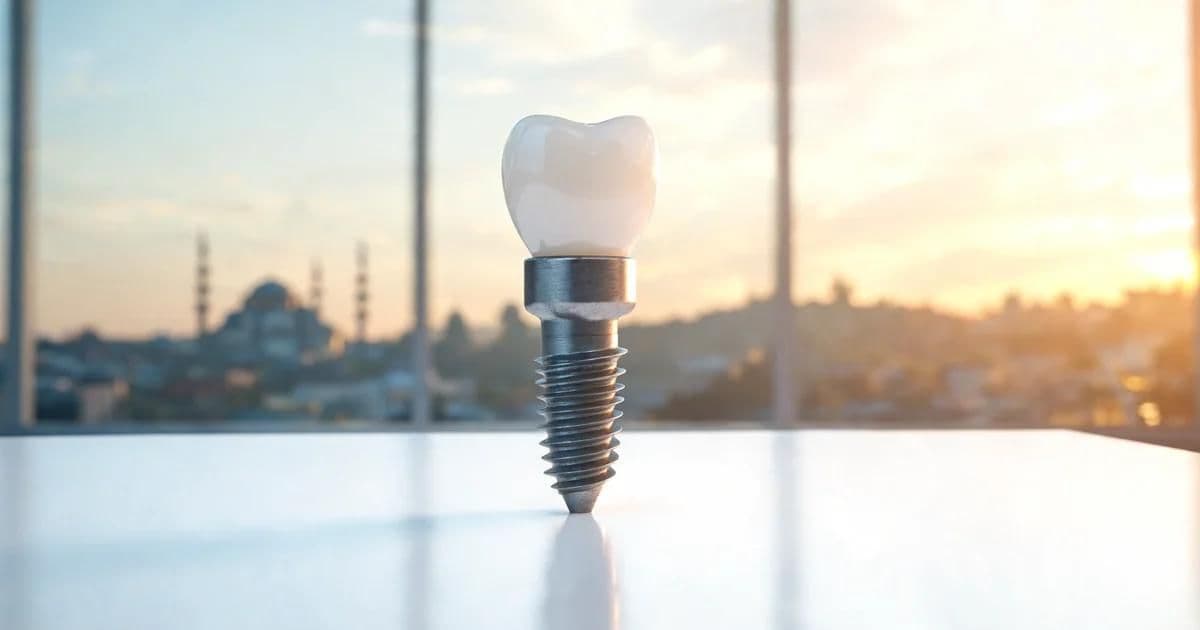
Yes. The same premium implant brands used in the UK, namely Straumann, Nobel Biocare, and Ivoclar restorative materials, are the standard in reputable Turkish clinics. These are imported at global list prices, so a Swiss titanium implant costs a clinic roughly the same to buy in Istanbul as in London. The price gap comes from everything around the implant, not the implant.
This is the part the rest of the internet skips, and it's the part that dismantles the "cheap means inferior" fear with arithmetic. Materials are priced globally. Labour is priced locally. A box of Straumann implants ships from Switzerland at the same wholesale cost wherever it lands, whether Birmingham, Berlin, or Istanbul. What differs is the wage of the surgeon, the rent of the building, the fee of the lab technician who mills your crown, and the general overhead of running the practice.
The implant itself costs a Turkish clinic roughly what it costs a London clinic, the difference is the wage, the rent, and the overhead around it, not the titanium in your jaw.
Once you separate the global cost (the materials) from the local cost (everything else), the whole picture makes sense. You are not buying a cheaper screw. You are buying the same screw with a lower wage and rent structure wrapped around it. For proof on the brands themselves, see our premium implant brands compared breakdown, and the wider dental implants in Turkey pillar guide.
Dental training is more affordable in Turkey because of the country's education structure, not because the training is shorter or thinner. Turkish dentists complete a five-year university dental degree, and more than 90 universities run dentistry programmes. A larger pipeline of graduates and a lower domestic education cost feed lower clinical fees without lowering skill.
Here is the quality engine most articles miss. More dentists graduating each year, combined with a very high volume of international cases concentrated in Istanbul, means a working Turkish implant surgeon often performs far more placements per year than a typical Western generalist. In implantology, repetition is competence. The hand that has placed several hundred implants reads bone, plans angulation, and manages soft tissue with a fluency that volume builds.
Many Turkish dentists also pursue postgraduate training in Germany, the UK, or the US, then return to a market with steady international demand. So the pipeline produces clinicians who are both well-trained and well-practised. The lower fee reflects a lower domestic cost of living and education, not a discount on experience. If anything, the case volume tilts the experience advantage the other way.
No. In an accredited clinic, a lower price reflects a lower cost base, not a lower standard. Quality is protected by independent signals: JCI accreditation (the international hospital-quality standard), Turkey's government-regulated International Health Tourism framework, the same premium brands, and implant success rates above 95% for well-placed cases. These are verifiable, not promises.
Are cheap dental implants in Turkey safe? The right way to read that question is to look at what holds quality in place. Joint Commission International accredits hospitals and clinics worldwide against the same clinical and safety benchmarks, and Turkey is among the leading countries for JCI-accredited facilities. You can confirm any clinic in the JCI accredited-organizations directory. On top of that, the Turkish Ministry of Health's International Health Tourism Regulation, administered through USHAŞ, licenses and inspects facilities that treat international patients and the agencies that refer them.
A lower price tag and a lower standard are two different things, and in an accredited clinic using Straumann implants, only one of them is true.
So the saving is structural and the safeguards are real. That said, quality varies between clinics in every country, which is exactly why verification matters, with more on that below. For the full quality, access, and aftercare picture, read our full Turkey vs UK comparison, and our dedicated answer to whether dental work in Turkey is safe.
Both Turkey and Mexico are major dental-tourism destinations with genuinely lower cost bases than the UK or US, and each has real strengths. Turkey's particular edge is that all four structural levers stack at once: a low domestic wage base, a favourable currency for international patients, an active government health-tourism policy, and an unusually high concentration of case volume in Istanbul.
Mexico's advantage is largely geography and labour cost, which suits North American patients well. Hungary built its reputation on EU-standard regulation and proximity for European patients. Turkey's draw, especially for UK and EU patients, is the combination: the same wage and currency advantages plus a deliberately built health-tourism infrastructure and the sheer scale of clinics operating in one city. Scale is the quiet factor, since high throughput spreads the fixed cost of imaging suites, sterilisation systems, and on-site labs across many more patients.
None of this is about one country being "the cheapest." It's about which structural stack fits your starting point. For a UK or EU patient weighing flight time, language support, and case volume together, Turkey's particular combination is hard to match.
Inside our Ataşehir clinic in Istanbul, an international implant patient moves through the same workflow a London practice would run, and the cost difference shows up in the wage and rent structure around that workflow, not in any single clinical step of it. Same brands, same imaging, same planning. Different economy.
A typical international case here runs through one sequence: consultation, CBCT 3D imaging, a written treatment plan, surgical placement using Straumann or Nobel Biocare implants, temporary teeth, then coordinated follow-up that includes liaison with the patient's UK dentist where needed. Our lead dentist, Dr. Taşkın Gürbüz, brings 15+ years of clinical experience and more than 500 successful implant cases to that surgical step. That depth of repetition is the case-volume factor made personal: it's not a discount, it's reps.
What stays identical to a Western practice: the implant brand, the CBCT planning, the sterilisation protocol, the warranty (we hold a five-year warranty on implant work), and English-speaking coordination from first message to final review. What changes: the rent on the building, the local wage base, the lab-technician fees. That is the structural saving, observed from the inside. No hidden costs, no cheaper screw, no less-qualified hand.
A genuinely good-value clinic saves money on its cost base, not on your treatment, and it will happily show you the evidence. The difference between structural affordability and corner-cutting is visible if you know what to ask for. Use this as a short checklist before you commit to any clinic, in Turkey or anywhere else.
- Confirm the implant brand in writing: Straumann or Nobel Biocare, not an unnamed "premium" implant.
- Look for JCI accreditation or ISO certification of the facility.
- Ask whether they use CBCT 3D imaging and provide a written treatment plan before surgery.
- Check lab turnaround and whether the lab is in-house or a known partner.
- Get the warranty in writing and confirm aftercare, ideally with home-country dentist coordination.
A clinic charging less for structural reasons answers all five without hesitation. A clinic cutting corners gets vague on at least one. For the deeper version of this, see our guide on how to choose a clinic in Turkey.
Dental implants are cheaper in Turkey for five structural reasons (lower overhead, a lower wage base, a favourable currency, government health-tourism policy, and high case volume), not because the implant is cheaper or the dentist less qualified. The materials are priced globally; only the labour and rent around them are priced locally. With JCI-accredited facilities, the same premium brands, and a five-year dental degree behind every placement, affordable here means structurally affordable, not lower quality. If you want a personalised look at your own case, get your free consultation with no price pressure, just a clear plan.
Dr. Taşkın Gürbüz is Lead Dentist and Medical Advisor at BestDent Ataşehir in Istanbul, specialising in implantology and prosthetic dentistry. He holds a DDS from Istanbul University and an Advanced Implantology Certification, with 15+ years of clinical experience and more than 500 successful implant cases treating international patients.
Credentials: DDS, Istanbul University · Advanced Implantology Certification · 15+ years clinical experience · 500+ successful implant cases.