A cosmetic-dentist's guide to a Hollywood Smile from London to Istanbul: the smile-design decision, the DSD mock-up you approve before any prep, shade psychology, and an honest list of who shouldn't get one.
Written and clinically reviewed by Dr. Ayla Gürbüz, DDS (Ankara University), Aesthetic Dentistry Specialization, 300+ smile transformations.
A Hollywood Smile is the full-smile-zone design outcome: uniform shade and shape across the 16 to 20 teeth that show when you talk and laugh. It's not a single procedure. Most London patients I scan arrive asking for one shade, BL1, the brightest on the guide. After they see their own face in the digital mock-up, the majority pick something two steps softer. That gap, between the shade you think you want and the one that looks right on camera, is the whole decision. For the underlying procedure mechanics, the Hollywood Smile in Turkey explainer covers the basics; this page is about the London-to-Istanbul design choice itself.
Hollywood Smile vs Veneers vs Smile Makeover: What You're Actually Buying
A Hollywood Smile is the aesthetic result: a fully designed smile zone where shade, shape, length, and gum line are planned together as one set. Veneers are one restoration type you might use to get there. A "smile makeover" is the umbrella term for any combination of cosmetic work. People conflate all three, then book the wrong scope.
The practical difference is units and intent. A single chipped front tooth needs one veneer, not a design. A Hollywood Smile usually means 16 to 20 units across the upper and lower smile zones, mixing veneers and crowns depending on each tooth's condition, with gum-line symmetry and a single chosen shade tying it together.
Why London Patients Look to Istanbul for a Full Smile Design
The pull is rarely one thing. London patients book a full smile design abroad because the work is extensive, the in-person design time in the UK is fragmented across multiple short appointments, and a Turkey plan compresses the whole thing into one continuous block. Cost matters, but I won't quote figures here. Think of it as a trip stack: return flights to Istanbul, a handful of hotel nights, and roughly five to seven treatment days. A London diary that would otherwise need six or seven separate visits collapses into one trip you can plan around.
There's also a trust problem, and pretending otherwise insults your intelligence. The "Turkey teeth" headlines are real. They almost always describe two failures: over-aggressive preparation and a shade chosen without reference to the patient's face. Both are design decisions, not country decisions. A well-run Istanbul plan and a well-run London plan make the same calls; a bad one in either city produces the same result. The rest of this guide is about telling them apart before you commit, so you can judge a clinic by its process instead of its postcode.
What a London Smile-Design Mock-Up Actually Shows You
Before any tooth is touched, a proper Hollywood Smile is designed digitally and shown to you for approval. This is the single most important appointment, and it's the one most cost-led pages skip.
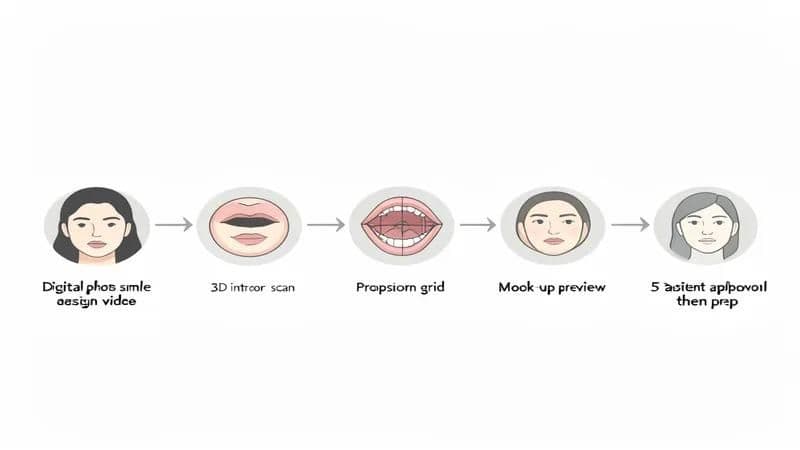
The five-stage digital smile design sequence: every step happens before any enamel is touched.
Here's the sequence I run for a London-origin patient:
Facial photos and video, taken relaxed, at full smile, and speaking. Teeth are designed to the face, not in isolation.
3D intraoral scan, a digital impression that replaces the old goopy trays and feeds the design software.
Proportion grid, where tooth width-to-length ratios and midline are checked against facial landmarks so the result reads as balanced, not pasted on.
Mock-up, a digital or wax preview placed over your real teeth. You see, and in many cases temporarily wear, the proposed smile before consenting.
Approval, then prep. Only after you sign off does any preparation begin.
The first-hand part worth sharing: across recent London-origin smile-design cases at our clinic, a clear pattern repeats. Roughly two in three patients arrive requesting BL1, the brightest shade, and after seeing it rendered against their own lip line and skin tone in the mock-up, they step down to B1 or A1, a natural-bright shade. The mock-up does the persuading; I rarely have to argue. The same group tends to settle on 8 to 10 upper units plus matching lowers once they realise the lower teeth show more than they expected when they laugh. A smaller share, usually patients with deep tetracycline staining or old crowns that won't bleach, keep the brighter shade because nothing softer will mask the underlying colour. You cannot get any of that feedback from a price list, which is exactly why I rate the mock-up appointment above every other step.
Shade Psychology: Why "Hollywood White" Often Looks Worse on Camera
Shade is where most regret lives. The classic Hollywood shade, BL1 or BL2, is the high-brightness white associated with film and red carpets. It photographs well under stage lighting and on darker skin tones. On a pale London complexion under ordinary daylight, the same shade can read as artificial, and that is the look people mean when they say "Turkey teeth."
The natural-bright shades, B1 or A1, are lighter than your natural enamel but stay credible in everyday light. They flatter most UK skin tones, age more gracefully, and survive being photographed at a wedding without looking like a filter. They also forgive small imperfections in gum line and lip symmetry that an ultra-white shade would only spotlight.
Three things should drive the choice: your skin tone, your lip line at full smile, and the lighting you actually live in. A thin upper lip shows more tooth and exaggerates brightness, so the same BL1 that looks composed on one face looks loud on another. There's also a practical point most people miss: your new shade is fixed. Porcelain doesn't respond to whitening, so whatever you pick is what you keep, and a shade that already looks bright in the chair will only look brighter once the temporaries come off. If a clinic agrees to BL1 without discussing any of this, that's a warning sign, not a service.
When a Hollywood Smile Is the WRONG Choice (and When London Is the Right Answer)
I turn people away from full smile designs regularly, because the wrong scope is worse than no treatment. A Hollywood Smile is the wrong choice if:
You have a single-tooth problem. One chip or one stained tooth needs one veneer. Don't prep 18 teeth to fix one. See the veneers hub for the targeted route.
You have active gum disease or untreated decay. Healthy foundations come first. Design over disease and the work fails.
You grind heavily and have no plan for it. Untreated bruxism cracks porcelain. You need a nightguard strategy before, not after.
You want BL1 on a thin, high lip line. The maths is against you. The mock-up will show you why.
You need reversibility. Once enamel is prepped and crowns are placed, there's no going back. If you're unsure, you're not ready.
You can't return for an aftercare visit if something needs adjusting. Coordinate this before you fly.
And here's when staying in London is the right answer: if your case is medically complex, if you need staged orthodontics in person before any cosmetic work, or if you simply value having a local dentist on call more than the cost difference. There is no shame in choosing proximity. For complex cases that combine missing teeth with smile design, the dental implants London-to-Istanbul guide and the All-on-4 London-to-Turkey comparison walk through the surgical side.
Veneers or Crowns Inside a Hollywood Smile? The Per-Tooth Call
A Hollywood Smile is rarely all veneers. Inside the same plan, the unit choice is made tooth by tooth:
Veneers for sound front teeth that need a colour and shape change, where enamel, bite, and spacing allow a conservative prep.
Crowns for teeth that are heavily filled, fractured, root-canalled, or structurally weak, where full coverage gives the strength a thin veneer can't.
A good design uses the most conservative option each tooth can support and reaches for crowns only where the tooth genuinely needs them. This is a clinical judgement, not a sales upsell, and it's worth asking any clinic to show you, tooth by tooth, why a given unit is a crown rather than a veneer. For the material-by-material detail, porcelain laminate versus E-max versus zirconia, read the dental veneers in Turkey guide; this page stays at the decision level on purpose.
The London-to-Istanbul Smile-Design Trip, Realistically
A full smile design is not a same-day procedure, and any page implying otherwise is selling. Realistically the sequence runs like this:
Before you fly: a virtual consultation, a review of your photos, and often a scan-sharing step so the design can start before you land.
The in-clinic block: roughly five to seven days covering the design appointment, preparation, temporaries, a try-in where you check the look, and final cementation.
Back in London: a settling-in period and a clear plan for who you call if a unit needs adjusting.
Budget the trip in days and appointments, not money. Plan the in-clinic block so your try-in and final fit don't fall on your departure day; leaving a clear day after cementation gives you room to flag anything that feels off before you board. Bring nothing you'd hate to chew around for a week, because temporaries are deliberately gentle. If you're combining the smile design with implants, add healing time and a second trip, and read the smile makeover in Turkey guide for how the staging works when treatments are combined.
How BestDent Designs a London Patient's Smile
At BestDent, every Hollywood Smile starts with the mock-up, not the drill. We run a full digital smile design and show you the proposed result against your own face before a single tooth is prepared, and we'll push back if a requested shade won't suit you. We use premium materials (E-max and zirconia), keep preparation as conservative as each tooth allows, and coordinate UK aftercare so a problem back home has a clear path. Our cosmetic work carries a 5-year warranty.
If you want to see your own smile designed before you decide anything, book a free virtual consultation and we'll prepare a digital preview. No pressure, no commitment.
About the Author
Dr. Ayla Gürbüz is a cosmetic dentistry specialist at BestDent in Istanbul, holding a DDS from Ankara University and an Aesthetic Dentistry Specialization. With more than ten years focused on veneers, crowns, and full smile design, she has completed over 300 smile transformations, many for international patients travelling from the UK and Europe. She reviews all cosmetic content for clinical accuracy.
Frequently Asked Questions
No. A Hollywood Smile is the full-smile-zone design outcome, not a single product. It may use veneers, but most plans mix veneers and crowns depending on each tooth's condition, and often add whitening or gum contouring. Veneers are one tool; the Hollywood Smile is the designed result.
Usually 16 to 20 units across the upper and lower smile zones, meaning the teeth visible when you talk and laugh. The exact number depends on how wide your smile is and how many lower teeth show. A consultation with photos confirms your count before any prep.
It's largely permanent. Once enamel is prepared and crowns are placed, the change can't be undone, only replaced later. If reversibility matters to you, consider minimal-prep veneers on fewer teeth instead, and discuss the trade-off at consultation.
Only if the shade and uniformity are chosen badly. Ultra-bright BL1 on a pale complexion under daylight reads as artificial. A natural-bright shade like B1 or A1, planned against your face in a mock-up, looks bright but believable. The design decision controls the result, not the country.
Plan for roughly five to seven treatment days in one trip, covering design, preparation, temporaries, a try-in, and final cementation. Pre-trip virtual consultation and scan review let the design start before you arrive, so the in-clinic time is used efficiently.
Preparation is done under local anaesthetic, so the appointments themselves are not painful. Some sensitivity while wearing temporaries is normal and settles. A conservative preparation approach reduces both discomfort and long-term risk to the teeth.
This is why aftercare coordination matters before you fly. A well-run plan gives you a clear contact and a path for adjustments, whether through a coordinating UK dentist or a return visit. Confirm the aftercare arrangement at consultation, not afterwards.
It's as safe as the clinic and the design. Verify premium materials, international certification, a digital-smile-design step with mock-up approval, and a clear aftercare plan. "Turkey teeth" failures trace to aggressive prep and poor shade choice, both avoidable with proper planning, and both held to the same standards you'd demand in London.
Sources
Digital smile design and facial-proportion principles in cosmetic dentistry.
Dental shade-guide systems (Vita Classical / bleach shades) and shade-selection literature.
UK General Dental Council guidance on treatment received overseas.
Whether it's your first visit or you're a returning patient, our team is here to provide you with personalized care in a relaxed and friendly environment.