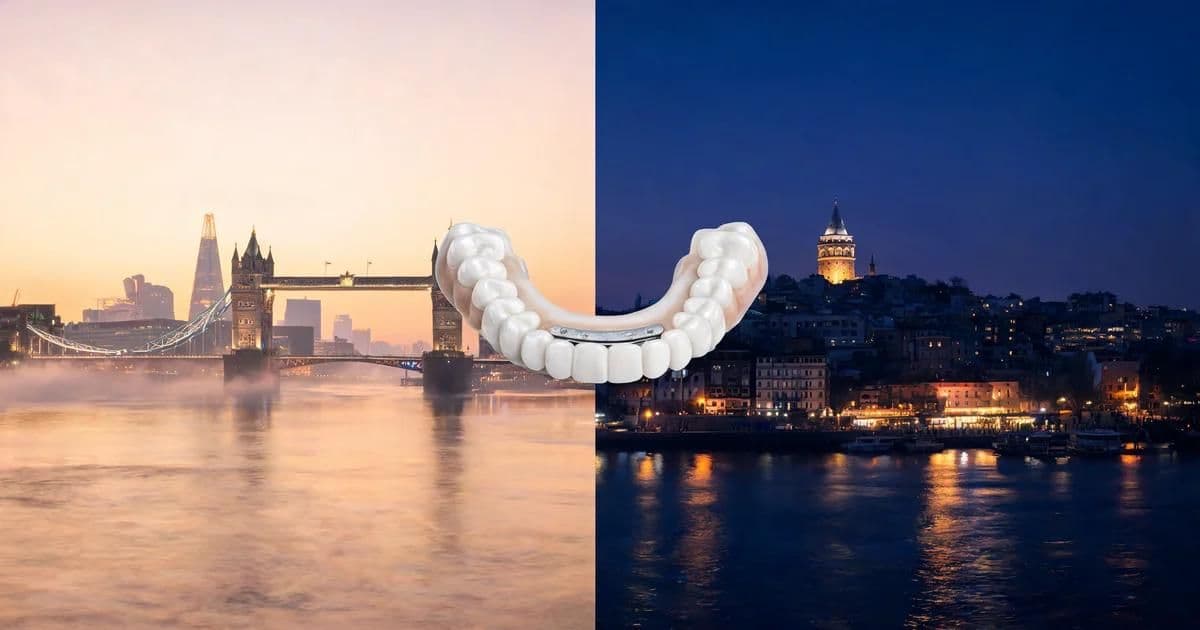
An honest stay-or-fly guide for UK patients facing full-arch loss: how your candidacy decides whether you fly to Istanbul once or twice, when staying in London is the smarter call, and what to do if a full-mouth implant fails after you fly home — by Dr. Taşkın Gürbüz.
Full mouth dental implants from London to Turkey rarely turn on the question patients arrive with. Most of our Ataşehir enquiries open with "how much" or "which clinic." The first thing we actually need to know is what your jawbone looks like on a CBCT scan, because that single image decides far more than your shortlist does. Roughly 96 to 98 percent of well-placed implants survive ten years (Moraschini et al., 2015), but that figure assumes the right candidate, in the right protocol, on the right timeline. Whether you fly to Istanbul once or twice is settled in your bone, not at the booking page. This guide is the step before you pick a protocol or a flight.
Key Takeaways
Your candidacy (bone volume and whether you need grafting) decides if you fly once or twice.
Staying in London is the right call for some patients; this guide names exactly when.
A full-arch failure after you fly home is manageable with an implant passport and UK coordination.
Why a Full-Arch Decision From London Is Different (Quick Summary)
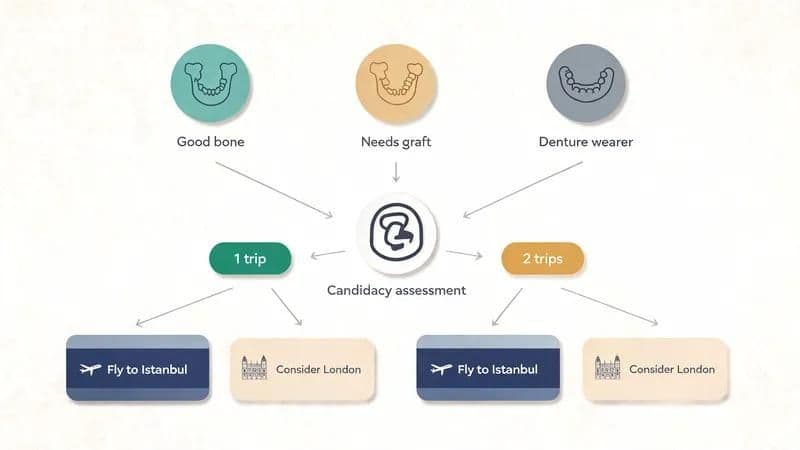
A full-arch decision differs from a single implant because complexity drives both the route and the trip count. Your bone volume, whether grafting is needed, and your current denture status determine whether you're a cleaner one-trip-leaning case or a graft-extended two-trip timeline. The stay-or-fly question is really a candidacy question wearing a travel costume.
That's why the matrix below starts with your mouth, not a price list, and why we won't quote figures here. For how the procedure itself works (osseointegration, All-on-4 versus All-on-6 selection, grafting mechanics), read our full guide to full mouth dental implants in Turkey. This post stays upstream of all that, on the decision.
Your situation
Likely route
Trip-count lean
Stay-or-fly lean
Good bone, no infection, fit to travel
Fixed full-arch, immediate-load eligible
Leans one or two trips
Flying is reasonable
Bone loss needing graft or sinus lift
Staged fixed arch
Leans two trips
Flying works if you can travel twice
Current denture-wearer, stable jaw
Denture to fixed transition
Often two trips
Depends on revision needs
Severe medical complexity
Assess in person first
Undecided
London may be safer
Happy with a well-fitting overdenture
May not need surgery
N/A
Staying often wins
No cell carries a number, and that's deliberate. The decision below is medical and logistical, not a discount calculation.
Are You a Full-Mouth Candidate, and Does That Mean One Trip or Two?
Most UK patients are candidates for some form of full-arch restoration. The real question is timeline. If your bone volume supports immediate-load implants, you lean toward a tighter schedule. If you need grafting or a sinus lift, the healing window stretches the case into a staged, two-trip plan. Whether you fly to Istanbul once or twice is decided in your jawbone, not at the booking page.
If your bone volume is good
Strong, infection-free bone in both arches is the cleanest scenario. You may qualify for immediate-loading protocols, the same approach Straumann and Nobel Biocare document for select full-arch cases. That doesn't guarantee a single trip, but it removes the biggest delay. A "full mouth dental implants Turkey, how long does it take" answer here is shorter than most patients fear.
If you need grafting or a sinus lift
Grafting adds healing time the calendar can't skip. Bone has to integrate before it can carry an arch, which usually means a planned return visit rather than one extended stay. If you're researching a dental bone graft in Turkey, assume a two-trip timeline and plan work leave around it.
If you're a current denture-wearer
Long-term denture-wearers often have measurable bone loss from years without root stimulation. That doesn't disqualify you. It just shifts you toward a staged plan and a careful first assessment.
Here's the honest intake observation worth more than any brochure: in our Ataşehir consultations, the single most common reason we ask a London full-arch patient to slow down is active, unassessed gum disease found at the first scan. Until that's controlled, no responsible surgeon should fix an implant date, and that finding quietly turns a hoped-for one-trip case into a staged two-trip plan. We'd rather tell you that on a video call than after you've booked flights.
Candidacy decides trip count, which shapes the stay-or-fly decision.
Stay in London or Fly to Istanbul? An Honest Decision Framework
Istanbul suits patients with a clear plan, a manageable case, and the ability to travel comfortably, ideally twice if grafting is involved. London suits patients who need frequent in-person revision access, can't take the time off, or carry medical complexity that's safer managed close to home. The framework is driven by your circumstances, not by a saving.
Think through four honest drivers before anything else:
Case complexity. A graft-heavy, multi-stage case demands more coordination than a clean arch. More complexity raises the value of being near your treating clinic.
Two-trip feasibility. If your case leans two trips, can you realistically fly twice, take the work leave, and recover each time? Be honest about your stamina and your calendar.
Recourse needs. How easily can you return for an adjustment? Patients who travel often find Istanbul straightforward; those who can't predict their availability should weigh that heavily.
Denture status. If you're transitioning from a denture and your jaw needs careful staging, the plan benefits from an unhurried timeline.
If you've already been told All-on-4 is your protocol, the protocol-level walkthrough lives in All-on-4 from London to Turkey, but this post sits one step above that choice. And whichever city you lean toward, verify the clinic properly: how to choose a dental clinic in Turkey is the checklist we'd hand a family member.
When Staying in London Is Actually the Right Call
Some patients should not fly for full-mouth implants, and saying so is the most useful thing a clinic can do. If your current overdenture fits well and you're genuinely happy with it, surgery may not improve your life enough to justify the trip. If you can't comfortably travel twice, or you need predictable in-person revision access, London removes a real source of stress.
Medical complexity matters most of all. Uncontrolled diabetes raises infection and integration risk; smoking can lift implant failure rates three to four times; recent radiotherapy to the jaw, or ongoing anticoagulation, needs in-person management. If your current overdenture fits well and you can't comfortably travel twice, staying in London may be the smarter call, and we'll tell you so. We'd rather lose a patient than place an arch we can't safely follow up.
Getting There: London → Istanbul (Not Just Antalya)
For UK patients, Istanbul is the practical medical-access route. Turkish Airlines and Pegasus run frequent direct flights from London Heathrow (LHR) and Gatwick (LGW) to Istanbul, with British Airways adding capacity; the hop is roughly three hours fifty to four hours. Antalya is leisure-led, a holiday hub more than a medical one. Istanbul's airport scale and clinic density make it the easier base for a multi-stage full-arch case.
We keep this brief on purpose. For the full route breakdown, transfers, and what to expect on landing, read the full London-to-Istanbul implant journey; there's no point repeating its table here.
If Something Goes Wrong After You Fly Home
If a full-arch implant loosens, an abutment fails, or you develop pain weeks after returning to London, you act on documentation, not panic. The single most important item is your implant passport: the brand, lot numbers, torque values, and radiographs of every fixture placed. An implant passport is the one document that turns a Turkish full-arch case into something a London dentist can safely follow up.
Demand it before you fly home, alongside a written warranty and a named contact for your treating surgeon. The General Dental Council is direct about overseas care: in its "Going abroad for dental treatment" guidance, the GDC notes that "if something goes wrong, it can be more difficult to sort out problems with treatment you've had abroad," and places responsibility on the patient to plan follow-up before travelling. There's no ban on overseas treatment, only a clear duty to organise aftercare in advance.
So organise it. Line up a UK dentist willing to monitor the work, understand the warranty mechanics, and know how to handle dental implant aftercare once you're home. A full arch carries more fixtures than a single implant, so the coordination stakes are higher, which is exactly why the passport and a UK contact matter more, not less.
How Best Dent Approaches Full-Arch Cases for London Patients
At Best Dent in Ataşehir, full-arch cases for London patients start with a CBCT-led virtual consultation, because we'd rather flag a problem before you book than after. We place premium brands only, Straumann and Nobel Biocare, under JCI and ISO-aligned standards, coordinate follow-up with your UK dentist, and back implant work with a five-year warranty.
Our protocol is deliberately conservative: if your case is better managed in London, or if active gum disease needs controlling first, we say so. That's the standard of care behind the honest disqualifier above. If you'd like a candidacy read on your own scans, book a free virtual consultation or message us on WhatsApp. No pressure, no commitment.
About the Author
Dr. Taşkın Gürbüz (DDS, Istanbul University) is Best Dent's Lead Dentist and Medical Advisor, with Advanced Implantology Certification, 15+ years of clinical experience, and 500+ successful implant cases including full-arch restorations for international patients. He provides medical oversight for all surgical and implant content on this site.
Frequently Asked Questions
It depends on your candidacy. A clean case with good bone and immediate-load eligibility can be a shorter, tighter timeline, while a case needing grafting or a sinus lift stretches across a healing window and usually means a planned return trip. Your CBCT scan, not a calendar, sets the schedule, which is why an honest assessment comes first.
It can be, with the right candidate and clinic. Well-placed implants show roughly 96 to 98 percent ten-year survival (Moraschini et al., 2015), and premium brands like Straumann and Nobel Biocare are the global standard. Safety hinges on verification: international certifications, proper assessment before treatment, and an aftercare plan. The GDC permits overseas care but expects you to arrange follow-up in advance.
Usually one or two, decided by your candidacy. Good bone volume and immediate-load eligibility lean toward fewer visits; grafting, sinus lifts, or significant bone loss lean toward a staged two-trip plan because healing time can't be skipped. The honest answer only emerges after a scan, which is why no clinic should promise a trip count before assessing you.
Sometimes, for the right candidate. Same-day full mouth implants in Turkey are possible when bone volume supports immediate loading, but they aren't right for everyone, and the provisional teeth fitted on day one aren't your final bridge. The mechanics of same-day teeth are covered in our All-on-4 from London to Turkey guide. Grafting cases generally can't be done in a single visit.
Often, yes. Many denture-wearers and patients with bone loss are candidates for a staged full-arch restoration, because bone loss usually shifts the timeline rather than ruling you out. Grafting can rebuild volume where needed. The deciding factors are your overall health, the bone available, and any active gum disease, all of which a CBCT scan and clinical assessment clarify.
You act on your implant passport. That document, listing brand, lot numbers, torque values, and radiographs, lets a UK dentist understand and follow up the work. Demand it before flying home, along with a written warranty and a named clinic contact. Arrange a UK dentist for monitoring in advance, and contact your treating surgeon promptly if you notice pain, looseness, or swelling.
Istanbul, for most UK patients. It's the major-hub medical-access route, with frequent direct flights from Heathrow and Gatwick and a dense concentration of implant clinics suited to multi-stage full-arch cases. Antalya is leisure-led, a holiday destination first. For a complex arch that may need a return visit, Istanbul's connectivity and clinical infrastructure make it the more practical base.
Cheaper isn't automatically better, and we won't pretend otherwise. Turkey is worth it when you're a sound candidate, choose a verified clinic using premium brands, and can manage the travel and aftercare. It's the wrong choice if you have severe medical complexity, can't travel twice when your case needs it, or are already happy with a well-fitting overdenture. Fit your circumstances first, and the value question answers itself.
Whether it's your first visit or you're a returning patient, our team is here to provide you with personalized care in a relaxed and friendly environment.