A clinician-reviewed guide to dental implants from London to Istanbul: the 2-trip journey, UK aftercare logistics, the implant passport you must demand, and honest answers about who is — and isn't — a candidate.
Clinically reviewed by Dr. Taşkın Gürbüz, DDS — 15+ years in implantology.
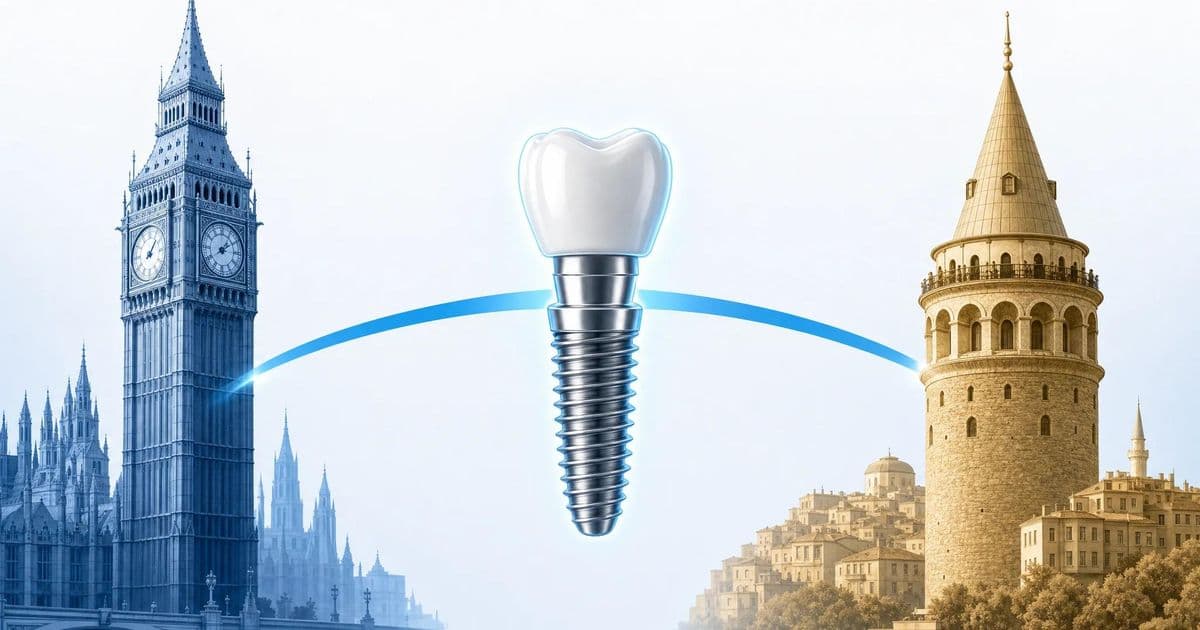
Dental implants from London to Istanbul means two trips, three to six months of healing in between, and one critical document — the implant passport — that bridges the gap to UK aftercare. You've seen the "Turkey teeth gone wrong" headlines. Let's address them with evidence, not platitudes.
The London-to-Istanbul dental implant journey is a two-visit process: a 4–7 day surgical visit, 3–6 months of osseointegration at home, then a 5–7 day return for crown placement. UK patients pay a fraction of central-London private rates through health tourism, with the same Straumann and Nobel Biocare implants used at London clinics — provided they coordinate UK aftercare and demand a complete implant passport.
| Factor | London (Private) | Istanbul (Health Tourism) |
|---|
| Trips needed | 1 (multi-stage local visits) | 2 (intensive blocks) |
| Total treatment time | 4–9 months | 4–7 months |
| Implant brands available | Straumann, Nobel Biocare, Astra Tech | Straumann, Nobel Biocare, Astra Tech, Neodent |
| Regulatory body | GDC (General Dental Council) | Turkish Ministry of Health + JCI/ISO |
| Aftercare model | Same-clinic follow-up | UK dentist coordination + clinic warranty |
| Cost level | UK private rates | Significantly lower than UK private rates through health tourism |
The journey is two flights, two clinical visits, and one healing window in between. UK patients fly direct from London (LHR/STN/LGW) to Istanbul (IST/SAW), spend 4–7 days for surgical placement, return home to heal for 3–6 months, then return for 5–7 days for crown fitting.
| Phase | Duration | Where |
|---|
| Trip 1 — Surgical placement | 4–7 days | Istanbul |
| Healing (osseointegration) | 3–6 months | At home, UK |
| Trip 2 — Crown fitting | 5–7 days | Istanbul |
A typical Istanbul package bundles airport transfers, hotel near the clinic, English-speaking interpreter, and post-op review appointments. Premium clinics include 3D CBCT scans and panoramic X-rays in both visits. For wider context, see our broader guide to dental implants in Turkey — the city-specific protocol on this page sits inside that broader framework.
One non-negotiable: osseointegration is the rate-limiting step — no clinic, anywhere in the world, can shorten it. The titanium fixture has to physically fuse with your jawbone. Marketing language that promises "implants in a week" is talking about temporary teeth, not finished work.
UK patients fly to Istanbul because NHS implant access is effectively closed, private London quotes are out of reach for most, and Turkish operating costs are structurally lower — not because quality is lower. The British Dental Association reports 86% of UK dentists have treated dental tourism patients post-return, indicating a mature aftercare ecosystem.
NHS dentistry access has narrowed sharply. Most NHS dentists across England now refuse new adult patients, and implants fall outside NHS coverage in nearly every case. That funnels patients into private care or overseas care. The squeeze is sharpest in regions like West Yorkshire, where the airport routing also changes the trip — if you're travelling from there, read our dedicated guide to dental implants from Leeds to Istanbul. The London private market is consultant-led, with central-London overheads, surgical-suite leases, and lab work all priced at UK rates. None of those costs are apologies for quality — they are the cost of operating on Harley Street.
Istanbul's lower price reflects structural costs: commercial rent in Ataşehir or Levent is a fraction of W1, dental salaries are calibrated to the Turkish economy, and lab work happens in-country. Implant fixtures are imported at the same European-distributor prices clinics pay in London. That's how Istanbul stays a fraction of central-London private cost through health tourism without dropping to a generic implant. For a head-to-head, see our comparison of UK and Turkish dental care.
The BDA's 86% figure is often misread. Most "complications" UK dentists see post-tourism are minor occlusion adjustments — not failures. My consistent advice to UK patients: lower cost reflects lower overhead, not lower standards. Verify the clinic, not the country.
Four direct routes operate London to Istanbul daily: British Airways (LHR–IST, ~3h45m), Turkish Airlines (LHR/STN/LGW–IST, ~3h45m), Pegasus (STN–SAW, ~3h50m), and AJet (STN–SAW, ~3h50m). Sabiha Gökçen (SAW) is the budget hub on the Asian side; Istanbul Airport (IST) is the main international hub.
| Airline | London Origin | Istanbul Arrival | Duration | Notes |
|---|
| British Airways | LHR | IST | ~3h 45m | Full-service, daily |
| Turkish Airlines | LHR / STN / LGW | IST | ~3h 45m | Multiple daily, includes meal |
| Pegasus | STN | SAW | ~3h 50m | Budget, Asian-side hub |
| AJet | STN | SAW | ~3h 50m | Budget, formerly AnadoluJet |
Which airport pairs with which clinic depends on the neighbourhood. Clinics in Ataşehir, Kadıköy, and the wider Anatolian side sit closer to SAW — a 25–40 minute transfer by car. European-side clinics in Şişli, Levent, or Beşiktaş are closer to IST. Most reputable clinics include private transfer in their package, so the airport choice is mainly about flight cost and schedule, not commute pain.
The flight after surgery is the part patients underestimate. Cabin pressure, dry air, and 3+ hours immobile are not friendly to a fresh surgical site. Most clinics build a 24–48 hour post-op buffer into Trip 1 before flying home, but read their protocol carefully — and our note on how soon you can fly after surgery.
Trip 1 (4–7 days) covers consultation, 3D CT scan, implant surgery, and healing-abutment placement. The patient returns home for 3–6 months of osseointegration — the bone-fusion phase that cannot be shortened. Trip 2 (5–7 days) covers final impressions, crown try-in, and permanent crown fitting. Total elapsed time: 4–7 months.
In our clinic, we typically schedule Trip 1 like this:
- Day 1. Arrival, check-in, initial consultation. No surgery on travel day.
- Day 2. 3D CBCT scan, panoramic X-ray, digital treatment plan finalised, written quote signed. Anaesthesia consent reviewed.
- Day 3. Surgery. Implant fixtures placed under local anaesthesia (sedation available). Healing abutments placed where bone density allows; otherwise, fixtures are submerged. Most patients walk out the same day.
- Days 4–5. Rest. Soft food. One review check at 48 hours to confirm no swelling outside expected range.
- Day 6. Final post-op review. Sutures checked. Preparing for your trip to Istanbul covers what to pack for this window.
- Day 7. Fly home with healing abutments in place, written post-op protocol, and a packet of medications.
This is the part the marketing brochures skip. Three to six months of healing is bone biology, not booking policy. The titanium fixture has to bond with bone — a process called osseointegration. Pushing crowns onto unhealed implants is the single most common cause of early-stage failure I see in returning patients.
How long depends on bone density (denser bone integrates faster), implant location (mandible heals faster than maxilla), whether grafting was done (add 2–3 months), and individual healing factors like smoking and diabetes control. Three months is the floor for premium-brand fixtures in healthy bone. Six is the realistic ceiling. You stay in the UK during this entire window. Routine cleaning at any UK dentist is fine — and sometimes recommended.
- Day 1. Arrival. Confirmation scan to verify osseointegration.
- Day 2. Final impressions taken (digital scan in most modern clinics). Trial crowns or temporaries fitted.
- Days 3–5. Lab work. Crown shade, shape, and bite adjusted across two or three fittings.
- Day 6. Final permanent crown cemented or screw-retained. Bite check.
- Day 7. Final review. Fly home with finished implant restoration and warranty paperwork.
Yes. Reputable Istanbul clinics use Straumann (Switzerland), Nobel Biocare (Sweden/USA), Astra Tech (Sweden), and Neodent (Brazil) — the same four brands stocked at GDC-registered London clinics. Peer-reviewed 10-year survival data places these brands above 95% across multiple meta-analyses. Verify the specific brand and lot number before flying home.
Straumann's published 10-year survival data and Nobel Biocare's clinical outcomes registry both track outcomes across hundreds of thousands of placed fixtures. A 2024 20-year meta-analysis confirmed survival rates above 90% even at the two-decade mark for these premium brands. That data does not change based on which side of the Bosphorus the surgery happened.
What does change between clinics is the brand actually used. Some budget Istanbul clinics quote a Straumann price and place generic Korean or Chinese fixtures. UK dentists cannot reliably service unknown fixtures — the abutment threading, torque specs, and warranty database all rely on knowing the brand and lot. Our Straumann vs Nobel Biocare brand comparison walks through how to recognize each system on a treatment plan.
If your Istanbul clinic can't tell you which brand and lot number went into your jaw, you don't have an implant — you have a guess. Demand the answer in writing before your sutures come out. That answer is the first item in the implant passport.
The implant passport is the documentation packet a Turkish clinic must give you before you fly home. It contains the implant brand and lot number, your 3D scan and X-rays, the full treatment plan, the warranty certificate, and your post-op protocol — everything a UK dentist needs to manage your aftercare or, if necessary, your warranty claim.
When I review a returning patient's records, this is what I look for, item by item:
- Implant brand + lot/batch number. Without this, no UK dentist can look up the abutment system, torque values, or warranty database. This is non-negotiable.
- 3D CBCT scan + panoramic X-ray (DICOM file). A printed image is not enough. Your UK dentist needs the digital file to load into their imaging software for any future planning.
- Treatment plan (signed, dated, with the surgical dentist's name and licence number). This is the legal record of what was done. The Turkish licence number is verifiable against the Ministry of Health register.
- Warranty certificate. Premium brands carry a 5-year minimum standard, with many clinics extending to 10. The certificate must name the patient, the fixture, and the failure conditions covered.
- Post-op protocol. Medications, follow-up schedule, red flags. This is the document your UK dentist will use during the first 6 months — and the document that distinguishes normal healing from early signs of what implant failure looks like.
- Direct contact for the surgical dentist. Not a generic clinic email. A WhatsApp number, direct line, or named patient liaison. If something goes wrong at month four, you need to reach the person who placed the fixture, not a reception desk.
Your implant passport is what turns a tourism story into a continuity-of-care record. Refuse to fly home without all six items.
UK aftercare for an Istanbul-placed implant works in three layers: routine cleaning at any UK NHS or private dentist (no surgical credentials needed); minor adjustments handled by a UK general dentist working from your implant passport; major issues handled by the Istanbul clinic under warranty, with travel coordinated through their UK patient liaison.
Layer one is simple. Any GDC-registered hygienist can clean around an implant crown. Bring your implant passport to the appointment so it goes into your UK record.
Layer two is where the implant passport pays for itself. A bite adjustment, a loose abutment screw, a chipped temporary crown — these are general-dentistry-level fixes a UK dentist can handle if they have the brand and torque specs. Without that paperwork, even a confident UK dentist will refer you back, because they cannot legally guess at proprietary components. Read our full aftercare protocol for what to ask your UK dentist before you fly.
Layer three covers warranty events: a fixture failure, peri-implantitis requiring surgery, or a fractured crown beyond field repair. These are rare under premium brands but real, and they belong with the original surgical team. The UK's Care Quality Commission regulates the UK clinic that handles your routine care, even when it does not regulate your Istanbul surgery — those two regulatory frames sit alongside each other, not against each other.
We run a UK-dentist coordination program for every London patient: a 5-year warranty on premium-brand fixtures, an English-speaking 24/7 post-op line, and direct hand-off of your implant passport to your UK dentist before you fly. If a layer-three event happens, we coordinate the return trip — including travel, where covered. Contact us for a personalised quote and aftercare plan.
Your London dentist doesn't need to have placed the implant to manage it — they need the records.
The General Dental Council does not prohibit UK patients from getting treatment abroad. Its public guidance focuses on understanding regulatory differences, ensuring continuity of care, and verifying the overseas dentist's qualifications. The GDC explicitly notes it cannot investigate complaints against dentists registered outside the UK.
Read the regulator's actual page: Going abroad for dental treatment. The GDC encourages patients to ask three questions before treatment abroad: who is the dentist registered with, what continuity of care arrangements exist, and what happens if something goes wrong. Those are the right questions. They are also the questions a complete implant passport answers.
What the GDC does not say is that overseas treatment is unsafe. It does not endorse UK clinics over Turkish clinics. It states a jurisdictional fact: the GDC's regulatory authority stops at the UK border. The Turkish equivalent — Ministry of Health licensing — picks up on the other side.
The GDC does not say overseas treatment is unsafe. It says it cannot regulate it. Those are different sentences. A clinic that cites the first version is misreading the regulator. For a deeper look at safety standards in Turkish dentistry, see our standards guide.
Five groups should not pursue London-to-Istanbul implants: heavy smokers, uncontrolled diabetics, patients with severe bone loss requiring multi-stage grafting, anyone unable to commit to two trips and a 3–6 month healing window, and patients unwilling to do the implant-passport homework needed for safe UK aftercare.
In 15+ years of implantology, the patients I've turned away most often fall into these groups:
- Heavy smokers (10+ cigarettes/day). Smoking raises implant failure risk 3–4× by impairing osseointegration. You can quit for the duration; if you can't, a London-placed implant under your existing dentist is the better path.
- Uncontrolled diabetics (HbA1c above 8%). Wound healing is compromised. Get glycaemic control first; revisit implants when stable.
- Patients with severe bone loss requiring multi-stage grafting. A bone graft + sinus lift + implant + crown protocol can stretch to four trips. The two-trip economics break down. Stay in the UK or accept the longer timeline upfront.
- Patients who cannot commit to two trips and a 3–6 month healing window. "I can only fly once" cases get pushed into compressed protocols that compromise outcomes. Do not negotiate biology.
- Patients unwilling to manage their own implant passport. If you won't ask for the lot number or carry your CBCT scan home on a USB stick, you are not in a position to manage UK aftercare. London is right for you.
If a clinic tells you everyone is a candidate, that is the answer to your question about that clinic.
Verify your Istanbul clinic in eight steps: (1) Turkish Ministry of Health licence number, (2) JCI or ISO 9001 certification, (3) named surgical dentist with verifiable credentials, (4) confirmed implant brand from the four UK-recognized options, (5) written warranty terms, (6) English-speaking surgical team, (7) GDPR-compliant records handling, (8) UK aftercare protocol on paper.
This is not a vibes assessment. Each step has a paper trail.
- Turkish Ministry of Health licence number. Every clinic has one. Verify against the Turkish Ministry of Health's licensing register before booking.
- JCI or ISO 9001 certification. Joint Commission International is the gold standard; ISO 9001 confirms documented quality processes. Either is meaningful; both is better.
- Named surgical dentist with credentials. Not "our team of experts." A specific person with a specific licence and verifiable postgraduate training in implantology.
- Confirmed implant brand. Straumann, Nobel Biocare, Astra Tech, or Neodent — in writing, before treatment. No "premium European" filler language.
- Written warranty terms. What is covered, for how long, and what voids it. 5 years minimum on premium fixtures.
- English-speaking surgical team. Not just an interpreter at reception. The dentist who places the fixture must be able to explain the procedure to you in English.
- GDPR-compliant records handling. You are an EU/UK data subject. Your CBCT scan and medical history fall under GDPR. The clinic must handle them accordingly.
- UK aftercare protocol on paper. Either a UK-dentist coordination programme or a written referral pathway for layer-two and layer-three events.
Eight verifiable signals beat one polished website. For the full framework, see our deeper guide on verifying a Turkish clinic step by step.
The London-to-Istanbul implant journey works for the right patient with the right paperwork. Two trips, three to six months of healing, and a complete implant passport — that is the full protocol. Skip any one of those, and you are taking on risk that does not need to exist.
If you fit the candidacy criteria, fly. If you don't, stay in London — and that's a clinical answer, not a sales one. Either way, ask the eight verification questions before you book anything. Contact us for a personalised quote and a candidacy review.