A 10-point self-check for dental implant failure, a red/amber/green urgency triage, and an honest guide for those who had implants abroad — based on peri-implantitis research.
This article has been clinically reviewed by Dr. Taşkın Gürbüz on behalf of the BestDent implantology team. Last medical review: 19 April 2026.
Around 96% of dental implants are still functioning after 10 years (Moraschini et al. meta-analysis) — but that means roughly 1 in 25 implants fails, and knowing the warning signs is what separates a simple intervention from a full implant replacement. If something feels off right now, you are not overreacting. We have reviewed hundreds of failing implant cases at our Istanbul clinic; the vast majority could have been caught months before turning into an emergency. Here is the 10-point check you can do at home tonight.
Medical Disclaimer: This article is for educational purposes and does not replace an in-person clinical examination. If you suspect your implant is failing, see a dentist.
The 10 most common signs of dental implant failure are: persistent pain beyond the second week, implant mobility, progressively worsening gum swelling, gum recession exposing the implant, bleeding when brushing or flossing, pus or bad taste, difficulty chewing, visible implant threads, numbness or tingling in the lip or jaw, and bone loss on X-ray. Any of these signs requires a dental assessment.
The Moraschini meta-analysis and the Howe et al. 2019 Journal of Dentistry systematic review confirm the long-term reliability of modern implants — but that 4–5% failure slice is real. The full list of warning signs:
- Persistent or increasing pain (beyond the second week)
- The implant feeling loose or mobile
- Swelling, redness or tenderness of the gum around the implant
- Gum recession exposing the implant collar or threads
- Bleeding when brushing or flossing
- Pus or bad taste/smell
- Discomfort or pain when chewing
- Visible metal threads or a grey shadow at the gum margin
- Numbness or tingling in the lip, jaw or tongue
- Bone loss on X-ray (your dentist sees this on imaging; your clue is a crater-shaped depression at the gum line)
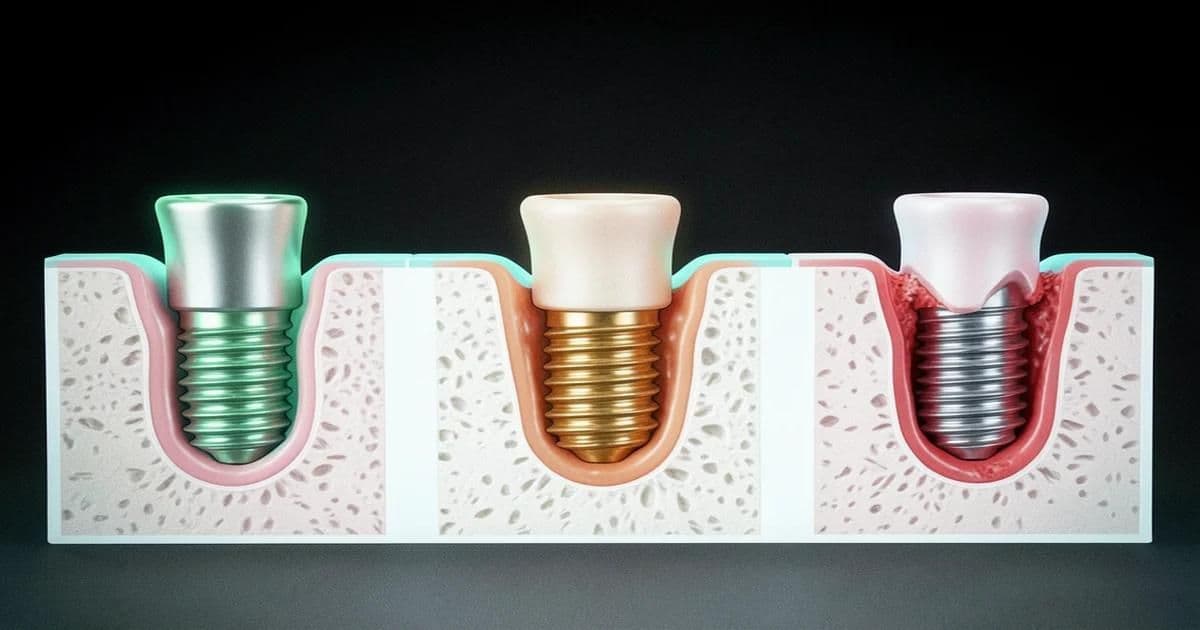
The sign our patients most often ignore is number 5 — bleeding when flossing. Unlike natural teeth, the gum around a healthy implant should never bleed. Never. If your implant has healed and you follow daily implant aftercare and bleeding starts, it means peri-implant mucositis (peri-implant inflammation) — reversible in its early stage, but left untreated it progresses to peri-implantitis.
Early dental implant failure happens within the first 3–6 months — before the bone has fully integrated with the implant. It usually stems from infection during healing, insufficient bone, or premature loading. Late failure occurs when the implant has been functional for more than a year and is almost always caused by peri-implantitis (a bone-destroying gum infection) or mechanical overloading.
The two scenarios differ markedly in cause, symptoms and salvageability. A BMC Oral Health 2022 systematic review shows peri-implantitis has a patient-level prevalence of approximately 19.5% — meaning roughly 1 in 5 implant patients will encounter it in their lifetime.
| Feature | Early Failure (0–6 months) | Late Failure (1+ year) |
|---|
| Timing | Before osseointegration is complete | After the implant is functional |
| Main cause | Surgical infection, soft bone, smoking, premature loading | Peri-implantitis (~22% of patients), bruxism, mechanical overload |
| Typical signs | Increasing pain after day 7, pus, mobility, failure to heal | Silent bone loss, gum recession, exposed threads, eventual mobility |
| Salvageable? | Rarely — implant is usually removed, site allowed to heal | Often yes if caught early (non-surgical debridement, LAPIP) |
| Prevention | Smoking cessation, atraumatic surgery, correct healing period | Annual hygiene checks, professional cleaning, night guard for bruxists |
We cover the implant healing timeline in a separate guide; the "early" column in this table is the mirror image of what normal healing looks like there.
Each warning sign points to a different underlying process. Some represent reversible inflammation, some advanced bone loss, and some rare but urgent neurological complications. The AAP 2017 Classification (Caton et al. 2018) sets the official definitions for peri-implant diseases.
Normal post-surgical pain is controlled and decreasing by days 5–7. Pain that is increasing after day 10 suggests bone inflammation, nerve proximity irritation or active infection, and should be evaluated within 48 hours.
A healthy implant has no perceptible movement. Any sensation of "play" or rocking when pressed with the tongue or a clean finger is a definitive sign of osseointegration failure — the situation rarely resolves without the implant being removed.
Localised, red, tender gum tissue around the implant is peri-implant mucositis — reversible in its early stage with good hygiene. When the same signs are accompanied by bone loss, it has become peri-implantitis. Gum disease and peri-implantitis are biological equivalents — but because implants lack a periodontal ligament, progression is much faster.
Gum recession is almost always the soft-tissue reflection of underlying bone loss. When we receive photos from patients who had implants abroad, the most commonly missed early sign is a grey shadow at the gum margin — patients do not notice until a hygienist points it out.
This is the earliest clinical sign of peri-implant mucositis — present even without pain or visible swelling. Occasional bleeding from natural teeth is common; a healthy implant should never bleed.
This is a sign of active infection and should be managed as an urgent evaluation, not a routine appointment. Pus is the clinically visible form of bacterial accumulation beneath a biofilm.
This suggests mechanical overloading, a crown fracture or a loose abutment screw. In patients with bruxism, the absence of a night guard is the most common contributing factor.
This indicates advanced bone loss. Although the gum change appears aesthetic, the underlying biological problem is far more serious and usually requires surgical intervention combined with bone grafting.
Numbness in the lip, jaw or tongue suggests nerve compression (Kochar, Reche, Paul Cureus 2022 — alveolar nerve proximity is a known risk in lower-jaw implant placement). Rare but urgent. If it does not resolve within 48 hours the implant position should be reassessed.
More than 2 mm of bone loss after the first year is the accepted pathological threshold (AAP 2017). Your dentist sees this on imaging; your clue is a crater-shaped depression at the gum line or the implant collar appearing to have risen above the surrounding bone.
Normal healing in the first 7–10 days includes mild swelling, bruising, pink-tinged saliva and mild pain controlled by ibuprofen. Red flags are pain that is worsening after day 7, pus, heavy bleeding lasting more than 24 hours, numbness that does not resolve, or an implant that feels loose. Red flags mean seeing a dentist within 48 hours.
Distinguishing normal healing from alarm signs is the most useful thing we can give a worried post-surgical patient. We cover the full 14-day healing timeline in a separate guide; the table below is designed for day-to-day decision support.
| Normal Healing (Weeks 1–2) | Red Flag — Act Now |
|---|
| Mild swelling peaking days 2–3, subsiding by day 5 | Swelling increasing after day 5 |
| Pain controlled by ibuprofen, decreasing daily | Pain returning or worsening after day 7 |
| Pink-tinged saliva for first 24–48 hours | Heavy bleeding beyond 24 hours, or fresh bleeding after week 1 |
| Mild bruising around the cheek | Hard, warm, spreading facial swelling |
| Mild jaw stiffness lasting a few days | Numbness/tingling not resolved within 48 hours |
| Implant feels firm, mild tenderness | Implant loose, rocking, or painful to touch |
A 5-step home self-check for a failing dental implant: (1) Look — use a bright light and mirror to check gum colour and swelling; (2) Feel — press gently on the implant with your tongue or clean fingertip; (3) Smell — check for bad breath or taste; (4) Bite — apply gentle pressure by biting on a soft piece of food; (5) Floss — floss gently around the implant; fresh blood is a red flag.
None of these replaces an examination, but done together they tell you whether you need a phone call tomorrow or an appointment this week.
- Look — Use your phone torch and a mirror. Check for changes in gum colour (healthy = pink; concerning = red/purple/grey), swelling, recession, or visible implant metal.
- Feel — Press gently with a clean fingertip. A healthy implant feels firm. Any sense of "play" or movement is significant.
- Smell — Wipe the gum margin around the implant with a piece of gauze or a clean tissue. Check for odour. A persistent bad taste or smell that does not clear with brushing suggests infection.
- Bite — Gently bite on a soft food item (not a pen). Pain on biting points to a mechanical or inflammatory issue.
- Floss Test — Gently floss around the implant crown. Fresh blood = mucositis (early peri-implant inflammation). Occasional bleeding from natural teeth is normal; implants should not bleed.
This protocol is a diagnostic aid for when you have a concern — not a routine addition to daily implant care — something to reach for when you are worried, not as part of your daily routine.
Red (emergency dentist within 24 hours): severe pain, fever, spreading facial swelling, heavy bleeding, numbness. Amber (routine appointment within 1–2 weeks): implant feeling slightly loose, taste/smell, bleeding when brushing, gum recession. Green (monitor, call if worsening): mild transient sensitivity in the first 2 weeks of healing.
| Level | Timing | Symptoms | Action |
|---|
| RED | Within 24 hours | Severe pain, fever, spreading facial swelling, heavy bleeding, new numbness | Emergency dentist / A&E / out-of-hours line |
| AMBER | Within 1–2 weeks | Loose feeling, taste/smell, bleeding on brushing, recession, chewing discomfort | Appointment with your implant dentist (or send a photo for remote review) |
| GREEN | Monitor | Mild transient sensitivity in first 2 weeks, minor bruising, slightly pink saliva on days 1–2 | Self-care; call if worsening or persisting |
Send a photo and a 60-second description. A BestDent implant specialist will review it within 24–48 hours and give you an honest clinical read: urgent care, routine check, or reassurance only. Free. No obligation. Even if we did not place the implant.
Get a Free Second Opinion → Message on WhatsApp
Peri-implantitis is a progressive infection of the gum and bone around a dental implant. It affects approximately 19–22% of implant patients. Unlike gum disease around natural teeth, peri-implantitis progresses faster because implants lack the periodontal ligament that slows bone loss. Early signs are gum bleeding; late signs are recession, pus and mobility.
According to the AAP 2017 classification, mucositis is inflammation confined to the soft tissue — reversible. Peri-implantitis is the irreversible form in which inflammation has progressed to the bone, showing progressive bone loss on X-ray. This is the tipping point for the entire disease.
The periodontal ligament that connects a natural tooth root to the bone acts as both a mechanical shock absorber and a biological defence line. An implant fuses directly to bone — that protective ligament does not exist. The result: the same biofilm biology as periodontitis, but a steeper bone-loss curve.
Smokers, people with poorly controlled diabetes (HbA1c >8%), those with a history of periodontitis, poor oral hygiene maintainers, and bruxists without a night guard (Kochar et al. Cureus 2022 risk factor summary).
EFP S3 Clinical Practice Guidelines (Herrera et al. 2023) recommend a stepwise protocol: Step 1 (hygiene and behavioural), Step 2 (non-surgical debridement + chlorhexidine), Step 3 (surgery in non-responding cases — LAPIP laser or regenerative surgery), Step 4 (supportive peri-implant therapy — lifelong). Preventive hygiene protocols are the foundation at every stage.
The most common causes of dental implant failure are: peri-implantitis (late failure), poor osseointegration due to insufficient bone or poor bone quality (early failure), smoking (4× higher failure rate), poorly controlled diabetes, bruxism without a night guard, surgical complications, and the use of generic unbranded implant systems whose components cannot be sourced globally.
The architecture of failure is not complex, but it is multi-factorial. A comprehensive review (Kochar, Reche, Paul, Cureus 2022) repeatedly highlights:
- Peri-implantitis (primary cause of late failure — separate section above)
- Insufficient bone volume or quality at placement
- Smoking — 2–4× higher failure rate
- Poorly controlled diabetes (HbA1c >8%)
- Bruxism / mechanical overload — load distribution is especially critical in full-arch restorations
- Poor surgical technique (thermal bone injury, incorrect angulation)
- Premature loading before osseointegration is complete
- Bisphosphonate use / MRONJ risk (its effect on bone healing is significant, Cureus 2022)
- Generic unbranded implants — component mismatch makes solutions harder to find in later years
- Material selection — success rate differences between zirconia and titanium require case-specific evaluation
Pre-treatment risk-reduction steps — smoking cessation, diabetes stabilisation, oral hygiene improvement — significantly lower failure rates.
Many failing dental implants can be saved if caught early. Non-surgical debridement and LAPIP laser treatment can halt peri-implantitis at the mucositis stage. If the implant must be removed, published implantology data show re-implantation success rates of 98.6% (first attempt), 96.1% (second attempt) and 91.7% (third attempt).
The rescue scenario is determined by stage. This is why the home self-check matters — early detection makes non-surgical intervention possible.
- Early-stage peri-implantitis → non-surgical debridement with chlorhexidine and mechanical decontamination. The EFP S3 guideline recommends this as the first-line approach.
- Advanced peri-implantitis → LAPIP (laser-assisted peri-implantitis protocol) or open-flap surgery, combined with regenerative grafting where needed.
- If implant removal is unavoidable → the site is allowed to heal, bone grafting is performed if needed, then re-implantation.
- Re-implantation success rates: 98.6% / 96.1% / 91.7% — values reported in published implantology meta-analyses. Multiple attempts are possible, each with slightly lower but still high success rates.
Honest framing: "saving a failing implant" is not a promise, it is a clinical decision. The decision depends on stage, bone quality and the patient's systemic health — the earlier you are in diagnosis, the more options you have.
We want to be honest in this section, because patients who have had implants abroad find this honesty nowhere else on the SERP. Medical Protection Society UK data show that approximately 34% of patients who received dental treatment abroad experienced a complication within 5 years and required corrective care in the UK.
There are real logistical challenges that should not be minimised:
- Returning urgently during a complication is difficult.
- Component compatibility — if the original implant is a generic/unbranded system, replacement drivers and abutments may not be available from UK dental suppliers.
- Insurance generally does not cover complications originating abroad.
- NHS and some private UK dentists decline to take on abroad-originated implant cases; this is a documented pattern in British Dental Journal (Nature 2024).
But there is also a solvable side:
- Premium brand components like Straumann and Nobel Biocare are stocked by UK dentists — a fact most patients do not know. Component compatibility is usually a problem with generic implants, not premium brands.
- A clinic with UK dentist coordination can establish the local follow-up care and remote review chain.
- A remote photo-based second opinion takes 24–48 hours and is sufficient in most cases to triage urgency.
We have coordinated follow-up care with many UK-based general dentists over a decade. When Straumann or Nobel components are used, abroad component matching is rarely the real problem — the real issue is usually the absence of a follow-up care model at the original clinic. How to verify safety standards at Turkish dental clinics and a realistic look at dental tourism are covered in separate guides.
Honest close: the 34% complication figure is real, but it is concentrated in the cheapest clinic tier and in structures with unbranded implants and no follow-up model. The right clinic structure resolves most of what that statistic measures.
This is the promotional section — but not a sales pitch, rather an educational explanation of our model. A clinic is as obliged to know what to do when an implant fails as it is to prevent failure in the first place.
-
Premium components only — We use Straumann and Nobel Biocare exclusively. These brands are globally stocked, meaning that if follow-up is needed in the UK or EU, components will be available. We eliminate the component mismatch problem of generic unbranded implants from the outset.
-
UK dentist coordination — Before discharge after treatment, we can liaise with your chosen UK-based general dentist: transfer of X-rays, treatment notes and a post-surgical review schedule. Not empty planning — a working process.
-
5-year warranty and remote review — Our implant work carries a five-year warranty. Within that window, a photo or video of a concern is reviewed by our dental team within 24–48 hours. The aspect patients most appreciate is that this guarantee operates as an active follow-up model, not just a "contact us if needed" statement.
-
English-language 24/7 post-operative support — We give patients a direct line to our clinical team throughout the critical healing window. The time difference does not matter; as soon as a concern surfaces, direction is given.
-
"Save the implant first" approach — When an implant (placed by us or by another clinic) shows signs of early failure, our default is the least invasive treatment that can preserve it: debridement and LAPIP before removal and re-implantation. We prioritise doing the right thing over the fast thing.
Our complete guide to dental implants in Turkey and full-mouth implant rehabilitation expand on this approach in clinical context.