A restorative dentist's guide to dental crowns from London to Turkey: the crown vs veneer vs bridge indication map, the marginal-fit rule that decides crown longevity, the honest two-trip timeline, and how to coordinate a debond back home.
If a London dentist has told you a specific tooth needs a crown, not a filling and not a veneer, then flying to Turkey changes the maths, but only when a crown is genuinely the right fix. A crown caps a tooth that is already compromised: root-canal-treated, cracked, or more than half old filling. Get the indication wrong and you have crossed the Channel for the wrong treatment, which is the most expensive mistake in this whole decision.
Do You Actually Need a Crown? Start Here, Before You Book Anything
A dental crown is a full cap that covers a damaged natural tooth on all sides to hold it together and protect it from breaking. It is not cosmetic facing, and it is not a replacement for a missing tooth. Before you compare clinics or flights, confirm the diagnosis fits, because three other treatments get confused with crowns every week in our Istanbul chair.
Here is the line that decides everything:
Treatment
What it fixes
How much tooth it covers
The tooth must be…
Typical trigger
Crown
A structurally weak but present tooth
All sides (360° cap)
Damaged but restorable
Root canal, large fracture, big failing filling
Veneer
The look of a healthy front tooth
Front face only (thin shell)
Sound and healthy
Cosmetic shape, shade, small chips
Onlay
Part of a damaged tooth
Biting surface + one or more cusps
Partly damaged, partly sound
Cracked cusp, when a full crown is overkill
Bridge
A gap from a missing tooth
Spans the gap, anchors on neighbours
Neighbouring teeth present (or implants)
One or more teeth already lost
If your tooth is sound and you want it to look better, you want a veneer, not a crown. If the tooth is already gone, you are looking at a bridge or an implant. Crowns sit squarely in the middle: the tooth is yours, it is still there, but it cannot survive on its own.
Why London Patients Are Crossing the Channel for Crowns Specifically
UK demand for overseas crowns is a quieter trend than the Hollywood-smile rush, and it comes from a different patient. NHS dentistry rarely covers a crown for anything other than strict clinical need, and private London crowns carry a high cost factor because each one involves a dentist's chair time plus an independent dental lab. For a patient facing several crowns after years of large fillings, the trip stack to Istanbul can come out far lower overall, even after flights and a hotel.
The London crown patient is usually older than the veneer crowd, often in their 40s to 60s, and arrives with a real problem rather than an aesthetic wish. A molar that split on a nut. A front tooth that went grey after a root canal a decade ago. Three teeth the dentist has been "watching" that finally need capping together.
That difference matters, because it changes what good looks like. A veneer is judged on shade and shape. A crown is judged on fit and longevity. For the broader cost-factor comparison between the two countries, our Turkey vs UK treatment guide breaks down where the savings genuinely come from.
There is also a timing pressure that pushes people across the Channel. Crown work tends to be cumulative. A tooth that needed watching becomes a tooth that needs a crown, and then a second one nearby catches up. NHS access for restorative work is uneven by region, and the private waiting time for several appointments can stretch over months when you are coordinating prep, lab, and fit visits around a working life in London. Consolidating that into one planned trip, with the lab time built in, is the practical draw rather than novelty.
The risk to be honest about is the same pressure cutting the other way. A patient with a single, simple crown often has no real reason to fly, because the saving on one tooth rarely justifies the trip stack and the follow-up friction. The maths turns favourable when you have multiple teeth to cap, when London private quotes have stacked up, or when a root canal plus crown on the same tooth would mean repeated London visits anyway. Be honest with yourself about which group you are in before you book.
Crown vs Veneer vs Implant: The Line That Keeps You From Booking the Wrong Trip
The single most common booking error we correct is a patient who asks for crowns when they need veneers, or veneers when they need crowns. The distinction is clinical, not marketing, so here it is in plain terms.
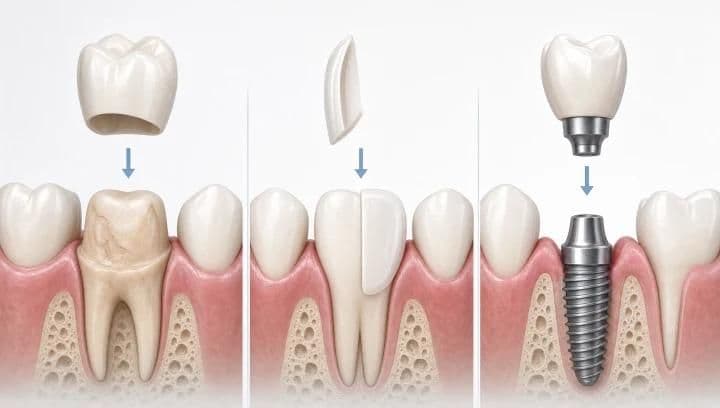
A crown is a 360-degree cap cemented over your own damaged tooth after it has been reshaped. It restores strength first and looks second. A veneer is a thin facing bonded only to the front of a healthy tooth, all looks and no structural job. An implant is a titanium root placed into the jaw to replace a tooth that is already missing, and it is then topped with its own crown, which is where people get confused.
So yes, a crown can sit on top of an implant, but that is a replacement journey, covered in our London to Istanbul implants guide. This article is about capping teeth you still have. This is not a veneers guide, and if your London consultation was about smile aesthetics on sound teeth, the veneers from London to Istanbul route is the one you want instead.
A crown caps your own damaged tooth, a veneer faces a sound tooth, an implant replaces a missing root
Get this right at the diagnosis stage and the rest of the trip is logistics. Get it wrong and no clinic, in London or Istanbul, can give you a good outcome.
The Margin Is Where Crowns Live or Die: What We Measure
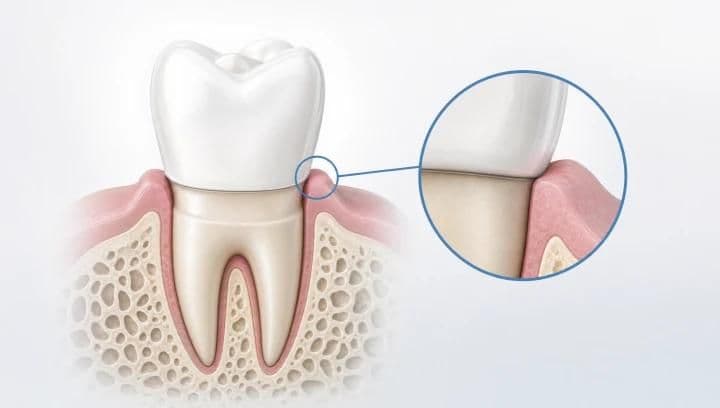
Ask most patients what makes a crown last and they say the material. Zirconia, E-max, the brand of ceramic. In our experience the material is rarely the failure point. The margin is. The margin is the junction where the edge of the crown meets your tooth, and if there is a gap there, bacteria get under the crown and decay the tooth it was meant to protect. The crown looks fine on day one and fails quietly underneath three years later.
In our Ataşehir lab we work to a marginal-fit target under roughly 120 microns, which is finer than a sheet of paper, and we reject any seating that does not meet it before cementation. We also cap how much tooth structure gets reduced during prep, because aggressive over-prep is the other half of the problem: shave too much and the tooth weakens and the nerve gets irritated.
This is the uncomfortable truth behind most "Turkey teeth" crown horror stories we see come in for revision: the failures we examine trace back to open margins and over-prep far more often than to the choice of ceramic. A premium material seated on a sloppy margin still fails. A modest material seated precisely lasts.
The marginal junction: where a crown either seals the tooth or lets decay in underneath
When you vet a clinic later in this guide, the margin is the thing the checklist is really protecting. It is invisible to you in the mirror and it decides whether your crown lasts five years or twenty.
Crown Materials Without the Hype: Zirconia, E-max, PFM
Once the indication and the margin are sorted, material is a genuine choice rather than a sales pitch. Three options cover almost every case.
Monolithic zirconia is the workhorse for back teeth. It is extremely strong, handles heavy chewing load, and is hard to chip. It is slightly more opaque, so it is less ideal for a single front tooth where translucency matters.
E-max (lithium disilicate) wins on aesthetics for front teeth. It mimics natural enamel translucency beautifully and bonds well, but it is less suited to high-load molars in heavy grinders.
PFM (porcelain-fused-to-metal) is the older option, still reasonable for some cases, though the metal substructure can show a grey line at the gum over time.
For a heavy-load molar, zirconia. For a visible front tooth, E-max. For a budget-driven posterior case, PFM remains defensible. We go deeper on lifespan and case selection in our general dental crowns in Turkey guide, so this section stays deliberately short: material is the easy decision once the harder clinical work is right.
The Honest Trip Plan: Why a Real Crown Usually Needs Two Visits, or One Careful One
A crown is a custom-milled object made by a dental lab from an impression of your prepared tooth. That physical reality sets the timeline, and any clinic promising a permanent crown the morning after you land is compressing a step that should not be rushed.
A realistic plan looks like this:
Visit one, day one to two: examination, any root canal needed first, then prep and a digital or physical impression. You leave with a temporary crown.
Lab stage, days two to four: the lab designs and mills the crown, and the clinic checks the fit and margin against the target before it touches your mouth.
Cementation, day four to six: the permanent crown is tried in, the bite is adjusted, and it is cemented once the margin checks out.
Same-day digital workflows (chairside milling) do exist and can be excellent for a single straightforward crown, but they are not a fit for every case, and they should never be used as an excuse to skip the margin check. If your tooth also needs a root canal first, that adds time and sometimes a healing gap, which is exactly the kind of sequencing you should confirm before booking flights. Our guide on preparing for dental treatment in Turkey covers how to plan the trip length around your specific case.
There is a sequencing wrinkle worth understanding, because it is where compressed trips most often go wrong. A tooth that needs a root canal before its crown sometimes needs a short settling period between the two, especially if it was painful or infected. Capping an angry tooth too soon risks trapping a problem under a permanent crown. A careful clinic will either plan that gap into a single longer stay or split it across two trips, and will tell you which before you commit to dates. A clinic that promises root canal plus permanent crown plus a chipped second tooth all inside three days is optimising for your flight schedule, not your tooth.
Front teeth add their own consideration. Matching a single front crown to the neighbouring natural teeth takes a try-in and sometimes a shade adjustment at the lab, which is hard to rush. If your crown is on a visible tooth, give the timeline room for that aesthetic check rather than treating it as a same-day job.
The honest version: budget for two visits or one longer single trip with built-in lab days. A weekend "crown" is a warning sign, not a convenience.
If a London-Made Plan Goes Wrong: Debonds, Recements, and the GDC
The fear that keeps London patients up at night is simple: what if it falls off or hurts once I am home? It is a fair question, and the honest answer is that a crown placed abroad is more awkward to follow up than one placed down the road, but it is far from a dead end.
If a crown debonds, most UK dentists, NHS or private, will recement an intact crown, because recementing is a straightforward procedure that does not depend on who made it. What they generally will not do is take clinical responsibility for the original work or remake it under any warranty. That is why the paperwork matters.
Before you fly home, get a crown record: the material used, the cement, the prep notes, and the lab details. This turns a confusing emergency visit into a five-minute recement for any London dentist. The General Dental Council does not prohibit overseas treatment, but it does expect UK dentists to act in your interest when you present with it, and good records make that easy. Our guide on whether dental work is safe in Turkey goes deeper on standards and what to verify.
Vetting a Turkish Crown Clinic: 6 Checks That Actually Predict Fit
Generic "is it accredited" advice is fine, but crowns have their own tells. These six checks are specific to crown work and to the margin problem above.
In-house or named lab. Ask whether the crown is made in-house or by a named partner lab, and how the fit is checked before cementation. Vague answers are a red flag.
Marginal-fit QC. Ask directly how they verify the margin. A clinic that does crowns well will have an answer; one that does not will deflect to the material brand.
A crown passport. They should provide material, cement, and prep records as a matter of course, not on special request.
On-site endodontics. If your tooth may need a root canal first, confirm they can do it properly on-site rather than rushing it to fit a crown deadline.
Conservative-prep stance. Ask how much tooth they remove and why. A clinic proud of minimal, precise prep is telling you something real.
ISO or JCI and named clinicians. Accreditation plus a named, credentialed dentist you can look up beats an anonymous package every time. Our full clinic selection guide expands each of these.
How BestDent Approaches Crowns
At Best Dent Ataşehir we treat the margin as the product, not the ceramic. Every crown is checked against a marginal-fit target under roughly 120 microns before it is cemented, root canals are completed properly before capping rather than squeezed into a travel deadline, and you leave with a full crown record for your London dentist. We will also tell you plainly when a tooth needs an onlay rather than a full crown, or when waiting is the better call. Get a free consultation and we will review your London X-rays before you book anything.
About the Author
Dr. Taşkın Gürbüz is Lead Dentist and Medical Advisor at Best Dent Ataşehir, Istanbul. He holds a DDS from Istanbul University with advanced certification in implantology and restorative dentistry, and has more than 15 years of clinical experience and 500-plus restorative and surgical cases. He provides the medical oversight for the clinic's crown and prosthetic protocols and reviews clinical content for international patients flying in from the UK and EU.
Frequently Asked Questions
It can be identical, because the materials (zirconia, E-max) and lab technology are the same globally. The variable is fit, not country. A precisely seated crown from a careful Istanbul clinic outlasts a rushed crown from anywhere, and the reverse is also true. Judge the clinic's marginal-fit process, not the postcode.
If your tooth is structurally damaged (root-canal-treated, cracked, or mostly old filling), you need a crown. If the tooth is healthy and you only want it to look different, you want a veneer. A crown wraps and strengthens; a veneer faces and beautifies. The wrong choice fails regardless of how well it is made.
Plan for two visits, or one longer single trip with built-in lab days, typically four to six days. The crown is custom-made by a lab from an impression, so a true permanent crown cannot be delivered overnight. Same-day chairside crowns suit some single cases but are not universal.
Most UK dentists will recement an intact crown that has simply debonded, because it is a quick, standard procedure. They generally will not take responsibility for the original work or remake it free. Bring a crown record (material, cement, prep notes) so any London dentist can help you fast.
Back teeth almost always do, because root canals leave the tooth brittle under chewing load and a crown prevents fracture. Front teeth sometimes manage without one. Your dentist should base this on the tooth's position and how much structure remains, not on a default upsell.
A well-fitted crown commonly lasts 10 to 20 years or more, and zirconia can run longer. The biggest factor is the margin seal and your hygiene, not the brand of ceramic. A crown with an open margin can fail in a few years even if the material is premium.
Yes, chairside digital milling can produce a same-day crown for a straightforward single tooth. It is genuine technology, not a gimmick. But it does not suit every case, especially multiple crowns or teeth needing a root canal first, and it must never skip the margin check to save a day.
An open or overhanging margin lets bacteria reach the tooth under the crown, causing decay that is hidden until it is advanced. This is the leading cause of crown failure we see in revision cases. A good clinic verifies the margin before cementing, which is why the fit process matters more than the material.
Sources
General Dental Council — guidance on treatment standards and overseas care: https://www.gdc-uk.org/
Whether it's your first visit or you're a returning patient, our team is here to provide you with personalized care in a relaxed and friendly environment.