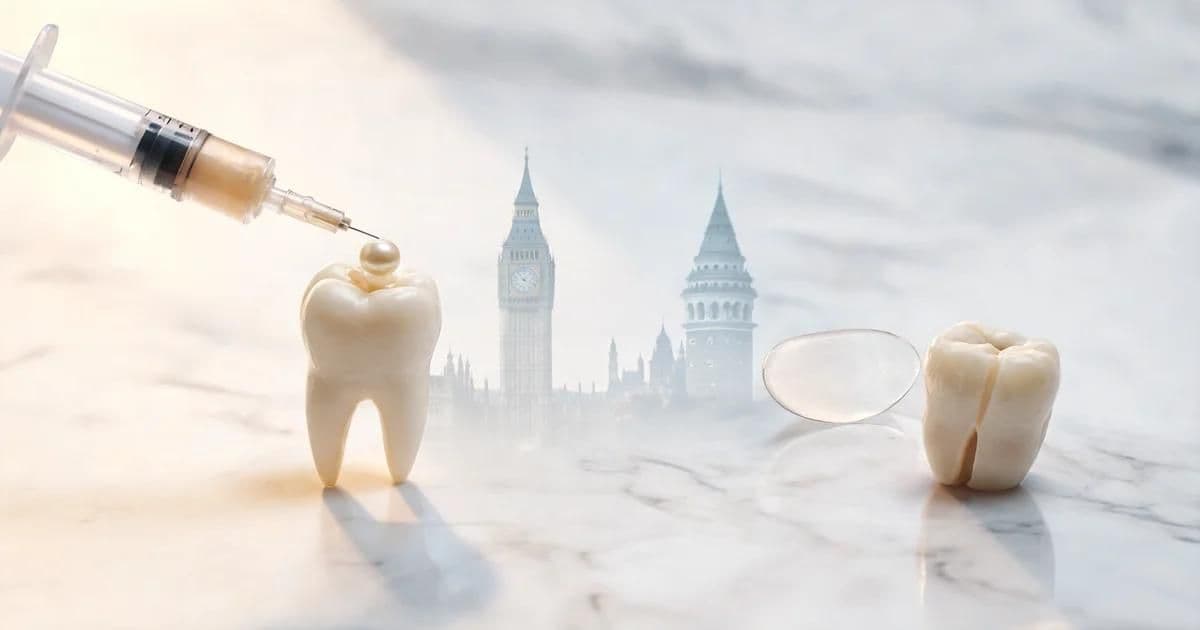
Composite bonding is the additive, no-drill cosmetic option — resin sculpted onto the tooth, nothing ground away. A cosmetic dentist explains what the GDC actually says about 'reversible,' when to fly to Istanbul, and when to stay in London.
Composite bonding builds your smile up rather than grinding it down. Roughly 0.1–0.2mm of enamel contact, no anaesthetic in most cases, tooth-coloured resin like 3M Filtek sculpted directly onto the edge. That single fact is why UK patients flying to Istanbul tend to ask the wrong question first. They want to know the price. The better question is whether bonding is even the right procedure for their teeth, and whether the "fully reversible" line every clinic repeats is actually true. The GDC says it mostly isn't. Here is the honest version.
Composite bonding adds material to the tooth; veneers and crowns take it away. That single difference is the whole decision.
Composite bonding is an additive cosmetic treatment: tooth-coloured composite resin is applied directly to your natural tooth, shaped, and cured with a light, usually in a single visit with little or no drilling. For a UK patient flying to Istanbul, that means a same-trip cosmetic fix for chips, small gaps, and worn edges.
| Composite bonding |
|---|
| Procedure type | Additive resin (built onto the tooth) |
| Drilling | None to minimal (0.1–0.2mm enamel contact) |
| Visits | Single, same trip |
| Longevity | 5–7 years typical; one retrospective review found 96% survival over ~7 years for anterior bonding |
| Reversibility | Conservative and additive (with an asterisk, see below) |
| Best for | Chipped edges, small gaps, minor shape and shade fixes |
| Not ideal for | Large gaps, heavy bruxism, full-arch transformations |
For the full chairside walkthrough (shade match, etch, layer, cure, polish), read the full chairside procedure steps. This guide is about the decision a UK patient faces, not the five steps in the chair.
No. Composite bonding is additive tooth-coloured resin with no prep. Porcelain veneers remove roughly 0.3–0.7mm of enamel to seat a thin ceramic shell. Crowns, what most people mean by "Turkey teeth", involve reducing the tooth by around 60–70%. Three different procedures, three very different amounts of healthy tooth lost, and patients conflate all three constantly.
That confusion is what drives the fear. The viral horror stories almost always involve crowns: a full mouth of teeth filed to pegs, not bonding. Bonding removes essentially nothing.
"Turkey teeth" are almost always crowns, aggressive tooth reduction, not bonding, which removes nothing.

If you want a full porcelain transformation rather than additive resin, read the veneers guide instead, or the broader veneer-types framework. And crowns are what "Turkey teeth" usually means, a separate decision with separate trade-offs. This post stays on bonding: the no-prep, single-visit, lab-free option.
Money is rarely the only driver. NHS access for cosmetic bonding is effectively nil, private waiting lists are long, and social-media "edge bonding" demand has exploded among under-35s. Add single-trip convenience and access to specialist cosmetic chairs, and a flight to Istanbul starts to make sense as a planning decision, not just a budget one.
Demand also skews by nation: bonding interest over-indexes in Wales, Northern Ireland, and Scotland, where NHS cosmetic access is non-existent and private waits drag on. That regional pattern matches what we see in enquiries.
For the wider context of comparing treatment at home versus abroad, see the wider Turkey-vs-UK treatment picture. Worth saying plainly: if your only motivation is shaving a bill on a single small chip, flying is usually not worth it. The case for travelling strengthens when you have several teeth to address in one sitting.
The other driver is time. A UK private cosmetic consultation, then a separate appointment for the bonding itself, then a review, can stretch across weeks of juggling work and a dentist's diary. An Istanbul trip collapses that into a few days you have already booked off. For image-conscious patients planning around a wedding, a holiday, or a new job, that calendar certainty is often worth more than any saving. None of this makes flying automatically right; it just explains why the decision is rarely about money alone.
Bonding does a specific set of cosmetic jobs well: chipped or worn incisal edges (edge bonding), small diastema or gap closure, and minor shape or shade corrections, all single-visit and lab-free. It is the social-media smile fix, which is exactly why younger UK patients search for it.
There is one rule people miss: composite cannot be bleached after it sets. If you want whiter teeth, whiten first, let the shade settle, then bond to match. Do it the other way round and your new resin stays the old colour while everything around it gets brighter.
Edge bonding deserves a word, because it is what most of the social-media demand actually wants. It adds a thin layer of resin to the biting edges of the front teeth to even out chips and wear, restoring length and a cleaner line without touching the rest of the tooth. It is fast, conservative, and reversible-ish (with the asterisk below), which is exactly why it spread on TikTok before most patients had heard the word "veneer."
Gap size matters too. Small gaps close beautifully with resin, built onto the inner edges of the two front teeth to narrow the space. Once you are past roughly 2–3mm, the resin starts to look bulky and short-lived, and orthodontics or veneers give a better, more durable result. That limit leads straight into when not to fly at all.
Yes, bonding is the most conservative cosmetic option available, but "fully reversible" is marketing language, not clinical fact. In its April 2026 "Bonding boom" blog, the General Dental Council (GDC) states plainly that while composite can technically be taken off, "achieving complete removal without altering or damaging enamel is extremely difficult." So: conservative and additive, yes. Truly reversible, no.
This matters because nearly every Turkey clinic page, and even the generic procedure hub, sells "reversible!" as the headline benefit. It overstates the case. The GDC goes further, warning that calling bonding "simple," "reversible," or "risk free" risks misleading patients and undermines valid consent.
In our cosmetic chairs we keep bonding at no-prep or that 0.1–0.2mm of enamel contact, and we still tell patients exactly this: even at the lightest touch, removing cured resin later means polishing against your real enamel. Conservative is the honest word. "Fully reversible" is not.
Bonding is the most conservative cosmetic option there is, but the GDC is right: "fully reversible" overstates it. Honesty about that is the test of a clinic worth flying to.
A clinic that repeats "100% reversible" without that asterisk is telling you what you want to hear, not what is true. That is a sorting signal on its own.
Sometimes the right answer is not to fly. Don't get on a plane for a single chipped front tooth: any UK dentist can bond that in half an hour. Skip bonding if you grind your teeth without a night guard, because composite shears off. Reconsider for gaps wider than 2–3mm, for still-shifting teeth under 25, and for any clinic you cannot verify against GDC-equivalent standards.
A meaningful share of the single-tooth enquiries we get from the UK, we advise to have done locally rather than fly. It is the wrong economics and the wrong logistics for one small repair.
If it's one chipped tooth, don't get on a plane. Any UK GDC-registered dentist can bond that in half an hour.
A Turkey clinic telling you to stay in London is the trust signal no aggregator will give you. The price-table sites never turn anyone away; the UK warning blogs turn everyone away. A calibrated "fly for these cases, stay for those" sits in the honest middle. The BACD (British Academy of Cosmetic Dentistry) standards are a useful yardstick for what proper cosmetic verification looks like wherever you are treated.
Good news: unlike porcelain, composite is chairside-repairable at any UK GDC-registered practice. A chip does not mean flying back to Istanbul. Bring home your shade and material record so a UK dentist can colour-match the repair in a single short appointment. That repairability is bonding's quiet advantage.
Contrast that with porcelain. A chipped E-max veneer usually needs full replacement, not a patch (see how a chipped porcelain veneer differs). Composite shaves the stakes considerably when something goes wrong at home.
On logistics: London airports (LHR, LGW, STN, LCY) run direct daily flights to Istanbul (IST) and Sabiha Gökçen (SAW), roughly 3h 50m–4h. Because bonding is single-visit, you fly out, get treated, and fly home on the same trip, with no return leg for a second appointment.
A chipped bonding is a half-hour repair at any UK dental chair; a chipped porcelain veneer often means starting over.
Dr. Ayla Gürbüz is a Cosmetic Dentistry Specialist (DDS, Ankara University; Aesthetic Dentistry Specialization) with over 10 years in cosmetic dentistry and more than 300 smile transformations completed. Her focus is veneers, composite bonding, smile design, and conservative aesthetic restorations, with a bias toward removing as little healthy tooth as possible.
Composite bonding is the additive, no-drill cosmetic option: resin sculpted onto the tooth, single-trip in Istanbul, and repairable at any UK chair if it chips. It is conservative, but not "fully reversible," whatever the marketing says. And honestly, for one small chip, having it done in London is often the smarter call.
If you are weighing the decision, get a free online photo consultation and we will tell you plainly whether flying is worth it for your teeth, or whether you are better off staying put.