A dentist's guide to getting dental crowns in Turkey -- crown types, the treatment timeline, how to evaluate clinics, and what your package should include. Written by an Istanbul cosmetic dentistry team.
Dental crowns in Turkey save patients a significant amount compared to UK or EU private fees -- using the same lab-grade zirconia and E-max materials. This guide covers crown types, the treatment process, and how to tell a quality clinic from a marketing machine.
| Feature | Detail |
|---|
| Crown types available | Zirconia, E-max (lithium disilicate), porcelain-fused-to-metal (PFM) |
| Cost vs UK | Significantly lower than UK private prices, same materials |
| Treatment duration | 5-7 days across 2-3 clinic visits |
| Material lifespan | PFM: 10-15 yrs / E-max: 10-20 yrs / Zirconia: 15-25 yrs |
| Who needs crowns | Root canal teeth, large fractures, worn teeth, cosmetic full-arch cases |
| Package typically includes | Treatment, hotel, airport transfer, digital scan |
| Recovery | Minimal -- eat soft foods for 48 hours, normal diet within a week |
| Key certifications to check | JCI accreditation, ISO 9001, named materials |
A dental crown is a custom-made cap that covers the entire visible portion of a tooth. Unlike fillings that patch a section, a crown replaces the outer shell entirely -- restoring both function and appearance.
You'll typically need a crown in these situations:
- After a root canal -- the tooth becomes brittle without its nerve and blood supply. A crown prevents fracture.
- Large cavity or broken tooth -- when more than 50% of the tooth structure is damaged, a filling won't hold long-term. A 2020 systematic review found that crowns on endodontically treated teeth significantly improve long-term survival compared to direct restorations alone.
- Worn-down teeth -- grinding (bruxism) or acid erosion can leave teeth too short. Crowns rebuild height and protect what's left.
- Cosmetic full-arch restoration -- patients wanting a complete smile transformation sometimes opt for crowns over dental veneers, especially when teeth are already damaged or heavily filled.
This is the question patients ask most. The distinction matters because it determines how much natural tooth gets removed.
| Factor | Crown | Veneer |
|---|
| Coverage | Entire tooth (360 degrees) | Front surface only |
| Tooth reduction | 1.5-2mm all around | 0.3-0.7mm front only |
| Tooth structure preserved | 28-37% | 75-95% |
| Best for | Damaged, weak, or root-canal teeth | Healthy teeth needing cosmetic improvement |
| Reversibility | No | Partially (minimal-prep types) |
The rule of thumb: if the tooth is structurally sound and you're improving appearance only, veneers preserve more of your natural tooth. If the tooth is compromised -- cracked, heavily filled, or root-canal treated -- a crown is the safer long-term option.
The material your crown is made from affects how it looks, how long it lasts, and which teeth it works best on. Here's a straightforward comparison.
| Property | Zirconia | E-max (Lithium Disilicate) | PFM (Porcelain-Fused-to-Metal) |
|---|
| Strength | Very high (900-1200 MPa) | High (360-400 MPa) | High (metal core) |
| Aesthetics | Good -- slightly opaque | Excellent -- most translucent | Acceptable -- metal margin can show |
| Lifespan | 15-25 years | 10-20 years | 10-15 years |
| Biocompatibility | Excellent | Excellent | Metal allergies possible |
| Best for | Back teeth, bruxism, bridges | Front teeth, visible smile zone | Budget option, back teeth |
| Dark line at gumline? | No | No | Yes (over time) |
A 2023 study in the Journal of Prosthetic Dentistry found monolithic zirconia crowns had a 97.6% survival rate at 5 years. E-max performs similarly for single crowns in the anterior region, with a systematic review reporting survival rates above 95% at 10 years for lithium disilicate restorations.
If you're getting zirconia crowns, you'll encounter two options. Monolithic zirconia is milled from a single block -- it's extremely strong and works well for back teeth, but slightly less translucent. Layered zirconia has a porcelain layer added on top for a more natural look, ideal for front teeth but marginally less durable. Most patients don't know this distinction exists, and clinics don't always explain it. Ask which type is being used for each tooth.
Our recommendation: Zirconia for back teeth and patients who grind. E-max for front teeth where translucency matters most. PFM is outdated for most cases -- it's cheaper but the metal margin darkens over time.
Getting dental crowns in Istanbul typically takes 5-7 days over 2-3 appointments. Here's the sequence.
- Full assessment -- panoramic X-ray, intraoral photos, and clinical examination. Your dentist checks for decay, gum disease, or bone issues that need addressing first.
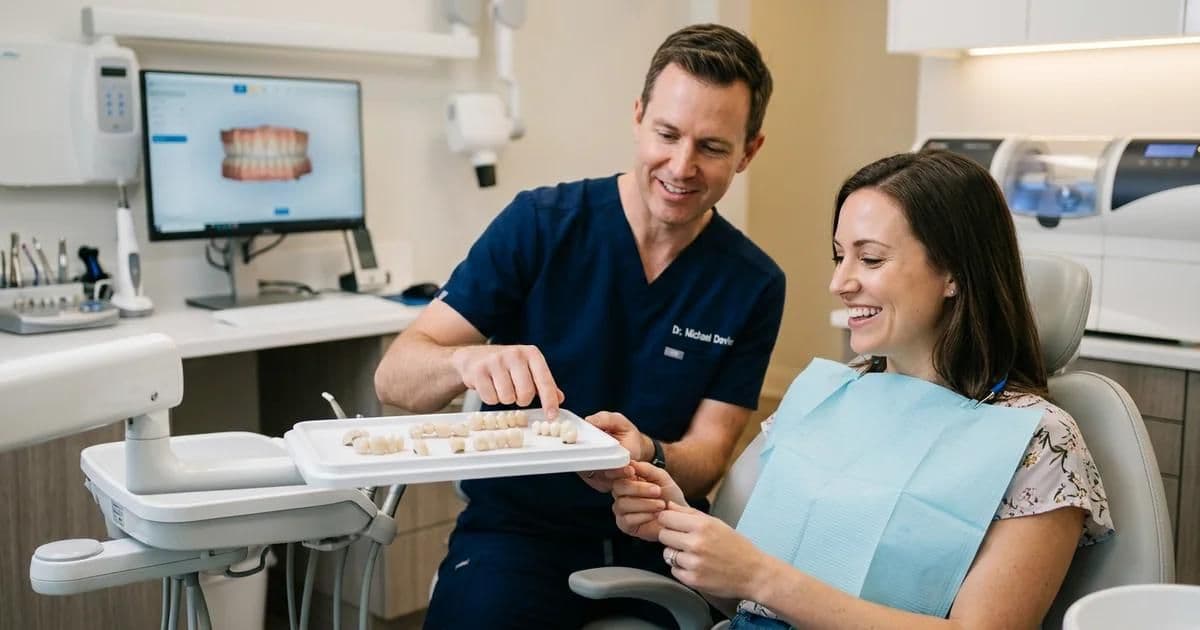
- Treatment plan -- you'll see exactly which teeth need crowns, the material recommendation, and a Digital Smile Design preview if you're doing front teeth.
- Tooth preparation -- each tooth is shaped down by 1.5-2mm to create space for the crown. This is done under local anaesthesia.
- Digital impression -- an intraoral scanner captures the prepared teeth in 3D. No messy moulds.
- Temporary crowns -- acrylic temporaries are placed immediately so you're never walking around with exposed stumps.
Your scans go to the dental laboratory where technicians CAD/CAM mill your crowns from solid blocks of zirconia or E-max. Shade matching happens during the first visit -- your dentist photographs your remaining natural teeth under calibrated lighting to ensure the lab matches the colour precisely.
- Try-in -- temporaries come off, permanent crowns go on for a fit check. Your dentist checks the bite, contacts between teeth, and colour match.
- Adjustments -- minor reshaping if any high spots exist. You'll bite on articulating paper to verify even contact.
- Cementation -- once everything checks out, the crowns are permanently bonded with resin cement.
- Aftercare instructions -- soft foods for 48 hours, avoid sticky or very hard foods for a week. Normal diet resumes after that.
Most patients fly home 1-2 days after the final fitting. The crowns are fully functional from day one -- there's no healing period like with implants.
You've probably seen the headlines. The phrase "Turkey teeth" went viral on TikTok and UK tabloids, showing patients with overly bulky, unnaturally white crowns -- or worse, with most of their natural tooth shaved down to pegs.
Here's the reality: those outcomes come from budget clinics fitting full crowns on healthy teeth that only needed veneers, or using one-size-fits-all designs instead of customising to each patient's face and bite. The material isn't the problem. The clinical judgement is.
A quality clinic will:
- Only recommend crowns when your teeth actually need them (not as a shortcut to a "Hollywood smile")
- Show you a Digital Smile Design preview before any preparation begins
- Use proportionate, natural-looking designs -- not the "chiclet" look
- Explain exactly how much tooth reduction is needed and why
If a clinic suggests crowning 20 healthy teeth for cosmetic reasons alone, get a second opinion. Veneers preserve far more tooth structure for purely cosmetic cases.
Dental crowns are one of the most predictable procedures in dentistry, but no treatment is risk-free. You should know:
- Sensitivity -- mild hot/cold sensitivity for 1-2 weeks after preparation is normal. It usually resolves on its own.
- Nerve irritation -- in rare cases (roughly 5-10% of teeth), the preparation can irritate the nerve enough to require a root canal later. Your dentist should discuss this possibility beforehand.
- Adjustment period -- your bite may feel slightly different for the first few days. Minor adjustments are normal and quick to fix.
- Crown loosening -- rare but possible, usually due to cement failure rather than the crown itself. A simple re-cementation fixes it.
None of these are reasons to avoid crowns. They're reasons to choose a clinic that explains them upfront instead of promising a problem-free experience.
Not every clinic advertising "dental crowns Turkey" on Instagram delivers the same quality. Here's what separates a good clinic from a risky one.
| Check | Green Flag | Red Flag |
|---|
| Accreditation | JCI accredited or ISO 9001 certified | No verifiable certification |
| Materials | Named brands (Ivoclar E.max, Prettau Zirconia, 3M) | Vague "premium ceramic" or "German materials" |
| Lab | In-house or named partner lab with CAD/CAM | "We work with the best labs" but no names |
| Dentist | Named prosthodontist, verifiable credentials | "Our team of experts" with no names |
| Digital workflow | Intraoral scanner, Digital Smile Design | Putty impressions only |
| Warranty | Written guarantee (3-5 years minimum) | Verbal-only promise |
| Follow-up | UK/EU dentist coordination, digital records sent | "Call us if something goes wrong" |
- "What brand of zirconia/E-max do you use?" -- if they can't name it, walk away.
- "Is your lab in-house or outsourced?" -- in-house labs allow same-day adjustments and better quality control.
- "Will you send my records to my local dentist?" -- a good clinic sends panoramic X-rays, treatment notes, and material certificates to your home dentist for continuity of care.
- "What happens if a crown fails within the warranty period?" -- get the answer in writing before treatment.
At BestDent in Istanbul, we only use premium materials -- Ivoclar E.max for anterior crowns and monolithic zirconia for posteriors. No PFM, no budget ceramics.
Here's what that means in practice:
- In-house digital lab -- your crowns are designed and milled in our clinic using CAD/CAM. No outsourcing, no waiting for couriers. If a shade needs adjusting, our technician is down the hall.
- Full digital workflow -- intraoral scanning (no putty impressions), Digital Smile Design previews, and 3D treatment planning.
- JCI-accredited and ISO 9001 certified -- these aren't marketing badges. JCI accreditation requires over 1,200 measurable standards covering patient safety, infection control, and clinical quality.
- UK dentist coordination -- we send your complete treatment records, X-rays, and material certificates directly to your home dentist. If something needs attention after you fly home, they have everything they need.
- 5-year warranty -- in writing, covering material and structural failure.
- All-inclusive packages -- treatment, hotel, airport transfers, and a dedicated English-speaking patient coordinator. No hidden fees after you arrive.
Want to know if crowns are right for your case? Send us a panoramic X-ray or a few clear photos of your teeth. We'll assess your situation and provide a personalised treatment plan -- no obligation, no pressure. Get a free consultation